How long
One day for the Mezquita and the centre; two to add the Alcázar, Medina Azahara and the patios at leisure.
Best time
Spring, especially May, during the Patios Festival. In summer Córdoba is one of the hottest cities in Spain.
Getting there (from Lisbon)
There are no direct flights: the easiest option is to fly to Seville or Madrid and take the high-speed train, about 45 minutes from Seville or 1h45 from Madrid. By car it's about 470 km, around 5 hours.
Ideal for
Lovers of history, Islamic architecture and small cities explored on foot.
Don't forget
A hat and a water bottle from May to September. The Córdoba sun is serious.
A thousand years ago Córdoba was one of the largest cities in the world, capital of Al-Andalus, with libraries, public baths, lit streets and Muslim, Jewish and Christian scholars. Today it's a mid-sized, white and peaceful Andalusian city, but it holds one of the most extraordinary buildings on the planet: a mosque with a forest of red-and-white arches and a cathedral built inside it. Add patios full of flowerpots, the narrow streets of the Jewish quarter and the best salmorejo in Andalusia, and you have one of Spain's most memorable visits.
The Mosque-Cathedral: an impossible building
Construction of the Mezquita began in the eighth century under Emir Abd al-Rahman I and was expanded over two centuries. The result is a vast hall with hundreds of marble, jasper and granite columns holding double arches in red and white stripes that seem never to end. Walking in for the first time is an experience that stays with you.
After the Christian conquest in 1236, the mosque became a church. In the sixteenth century a Renaissance cathedral was built in the middle of the hall of columns. Emperor Charles V is said to have lamented, on seeing it, that something unique had been destroyed to build what could be built anywhere. Today the coexistence of the two is exactly what makes the building so special.
Don't miss the mihrab, the prayer niche decorated with golden mosaics, and the Courtyard of the Orange Trees at the entrance. The old minaret is now the bell tower and can be climbed for a view of the city.
The Roman bridge and the Guadalquivir
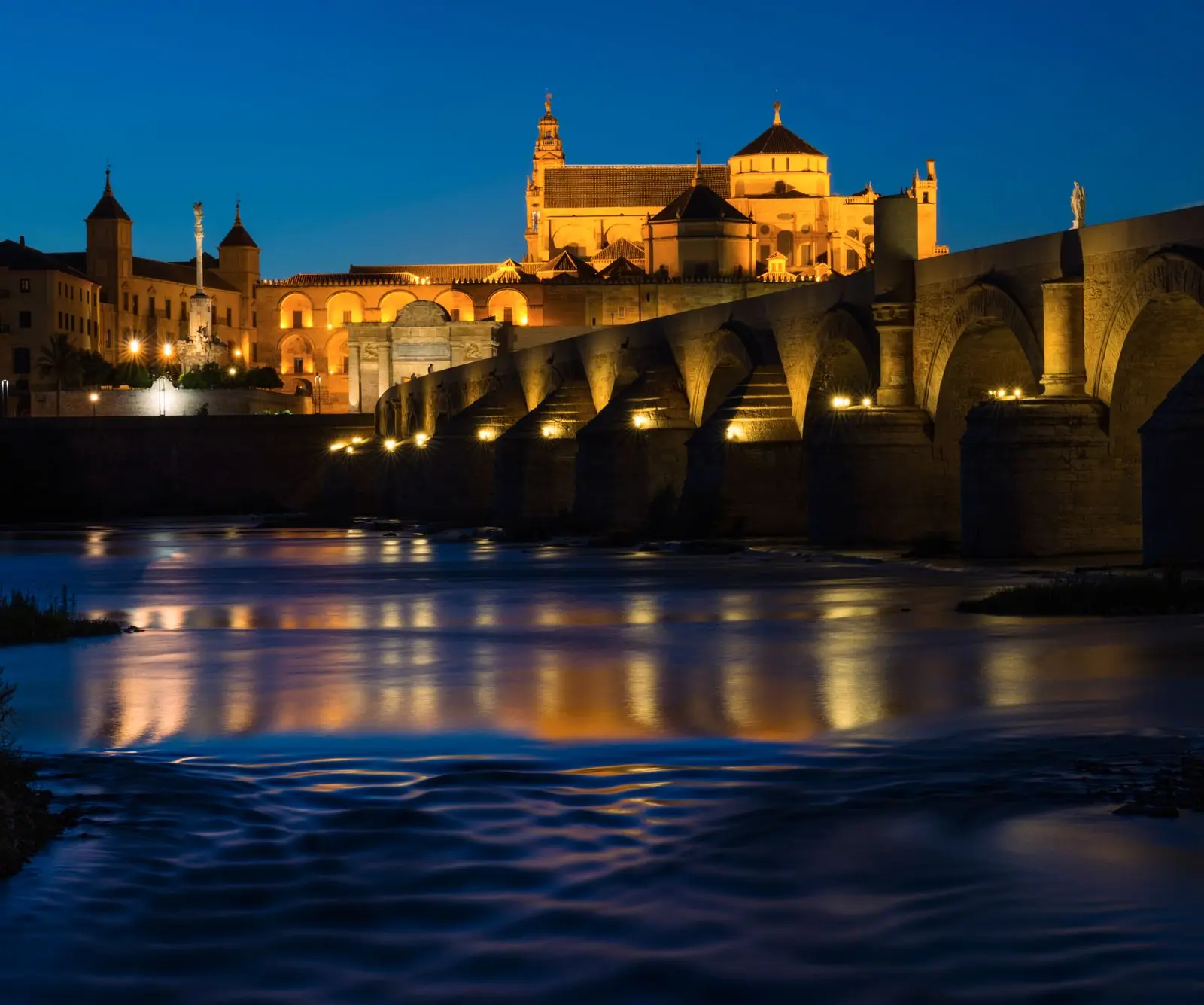
The Roman Bridge crosses the Guadalquivir right in front of the Mezquita, with sixteen arches and two thousand years of history, though much rebuilt. On the other side stands the Calahorra Tower, a medieval fortress with a small museum about the coexistence of the three cultures.
The best view of the Mezquita is from this bridge, especially at sunset and at night, with the illuminated building reflected in the river. TV fans will recognise the setting from well-known productions.
By the river there are also old water mills, such as the Albolafia Mill with its large wheel, and a pleasant walk along the bank.
The Jewish quarter: white streets and Calleja de las Flores
The old Jewish quarter lies right next to the Mezquita and is a maze of narrow streets, whitewashed houses, wooden doors and hidden patios. It's the city's most beautiful neighbourhood for getting lost on foot.
Calleja de las Flores is the most photographed street: narrow, with flowerpots on the walls and the Mezquita tower at the end. Nearby is the Córdoba Synagogue, from the fourteenth century, one of the few medieval synagogues to survive in Spain.
In a small square stands the statue of Maimonides, the Jewish philosopher and physician born in Córdoba in the twelfth century. It's a reminder that the city was for centuries a centre of learning for several faiths.
The patios of Córdoba
Córdoba's patios are inner courtyards of houses, covered in flowerpots hanging on the walls, with fountains and wells, designed to cool the house in the heat. In May, during the Patios Festival, residents open them to the public and compete for the most beautiful.
The festival is UNESCO Intangible Cultural Heritage and one of the most charming moments of the year in Spain. The San Basilio and Santa Marina neighbourhoods have the most famous patios, and there are marked routes to visit them.
Outside May, some patios stay open to the public through the year, and the Viana Palace, with twelve different patios, shows the tradition well.
The Alcázar and Medina Azahara
The Alcázar of the Christian Monarchs is a fortress with magnificent gardens, pools, fountains and cypresses. It was here that the Catholic Monarchs received Christopher Columbus before his voyage to the Americas. The walls and towers offer good views of the Mezquita.
About 8 km from the city lie the ruins of Medina Azahara, a palace-city built in the tenth century by Caliph Abd al-Rahman III and destroyed only a few decades later. It was listed as a UNESCO World Heritage Site in 2018 and shows halls, arches and gardens of the caliphal court.
You need transport for Medina Azahara, as it's outside the city. A private tour lets you combine the Mezquita, the centre and Medina Azahara on the same day, or visit Córdoba from Seville.
A perfect day in Córdoba
08:30
Mosque-Cathedral
Entry at opening, the mihrab, the cathedral and the Courtyard of the Orange Trees.
10:30
Bell tower
Climb the old minaret for a view of the city.
11:30
Jewish quarter
Calleja de las Flores, the synagogue and the statue of Maimonides.
13:30
Lunch
Salmorejo, flamenquín and aubergines with cane honey.
16:00
Alcázar of the Christian Monarchs
Gardens, fountains and walls, in the shade during the hottest hours.
18:30
Roman bridge
Sunset with the Mezquita reflected in the Guadalquivir.
21:00
Dinner and patios
Tapas in a flower-filled patio and a glass of Montilla-Moriles wine.
What it costs
Córdoba is cheaper than Seville or Granada. The Mezquita is the most expensive ticket, and worth every cent.
Budget
60–100 €
per person, per day
Hostel, tapas, the Mezquita and the Alcázar, and plenty of streets and patios to see for free.
Comfortable
130–220 €
per person, per day
Hotel in the centre, the Mezquita, the Alcázar, Medina Azahara and a flamenco show.
No expense spared
300–600 €
per person, per day
Mansion hotel with a patio, chef-led restaurants and a private tour from Seville.
Hostel bed
per night · More expensive in May
25 € – 45 €
Mid-range hotel in the centre
per night, double room
75 € – 140 €
Boutique hotel in a mansion
per night, double room
160 € – 300 €
Mosque-Cathedral
per person
12 € – 15 €
Alcázar of the Christian Monarchs
per person
5 € – 10 €
Medina Azahara
per person · Transport costs extra
5 € – 12 €
Tapas and a drink at lunch
per person
12 € – 20 €
Dinner with wine
per person
25 € – 45 €
Flamenco show
per person · Sometimes includes a drink
20 € – 35 €
Approximate reference values for 2026. Always check before you go.
Tourist mistakes to avoid
- ✕Visiting Córdoba at noon in July without a hat. Temperatures easily hit 40 degrees.
- ✕Rushing through the Mezquita. It needs at least an hour, ideally more.
- ✕Coming for the Patios Festival without booked accommodation.
- ✕Seeing only the Mezquita and ignoring the Jewish quarter and the Alcázar.
- ✕Ordering gazpacho in Córdoba without trying salmorejo. It would be a local offence.
- ✕Forgetting Medina Azahara, which many people don't even know exists.
«Córdoba has more columns than tourists. Early in the morning, at least.»
More photos of Córdoba
Frequently asked questions
How do I get from Lisbon to Córdoba?
There are no direct flights. The easiest option is to fly to Seville and take the high-speed train, about 45 minutes, or fly to Madrid and take the train, about 1h45. By car it's about 470 km.
How long does a visit to the Mezquita take?
At least an hour, ideally an hour and a half. Add the bell-tower climb if you have time.
What is the Patios Festival?
A May festival when residents open their flower-filled patios to the public and compete for the most beautiful. It is UNESCO Intangible Cultural Heritage.
What is Medina Azahara?
The ruins of a tenth-century palace-city built by Caliph Abd al-Rahman III, about 8 km from Córdoba. It has been a UNESCO World Heritage Site since 2018.
Can I visit Córdoba as a day trip from Seville?
Yes. The high-speed train takes about 45 minutes. In a day you can see the Mezquita, the Jewish quarter, the Alcázar and the Roman bridge.
Prices, opening hours and rules are approximate reference values and may change: always check before you go. Photos: Pexels.