How long
Two or three days for the city and a day trip. With more time, Málaga is the perfect base for Andalusia.
Best time
Spring and autumn, with sunshine and mild temperatures. Summer means beach and heat; winter brings a mildness rare in Europe.
Getting there (from Lisbon)
There are direct flights from Lisbon of about an hour and a half. By car it's about 650 km, over six hours. From Madrid, the high-speed train takes around two and a half hours.
Ideal for
Anyone who wants city and beach in one trip, art lovers, tapas lovers and fans of long sunny days.
Don't forget
Sunscreen all year and comfortable shoes for the climb to Gibralfaro.
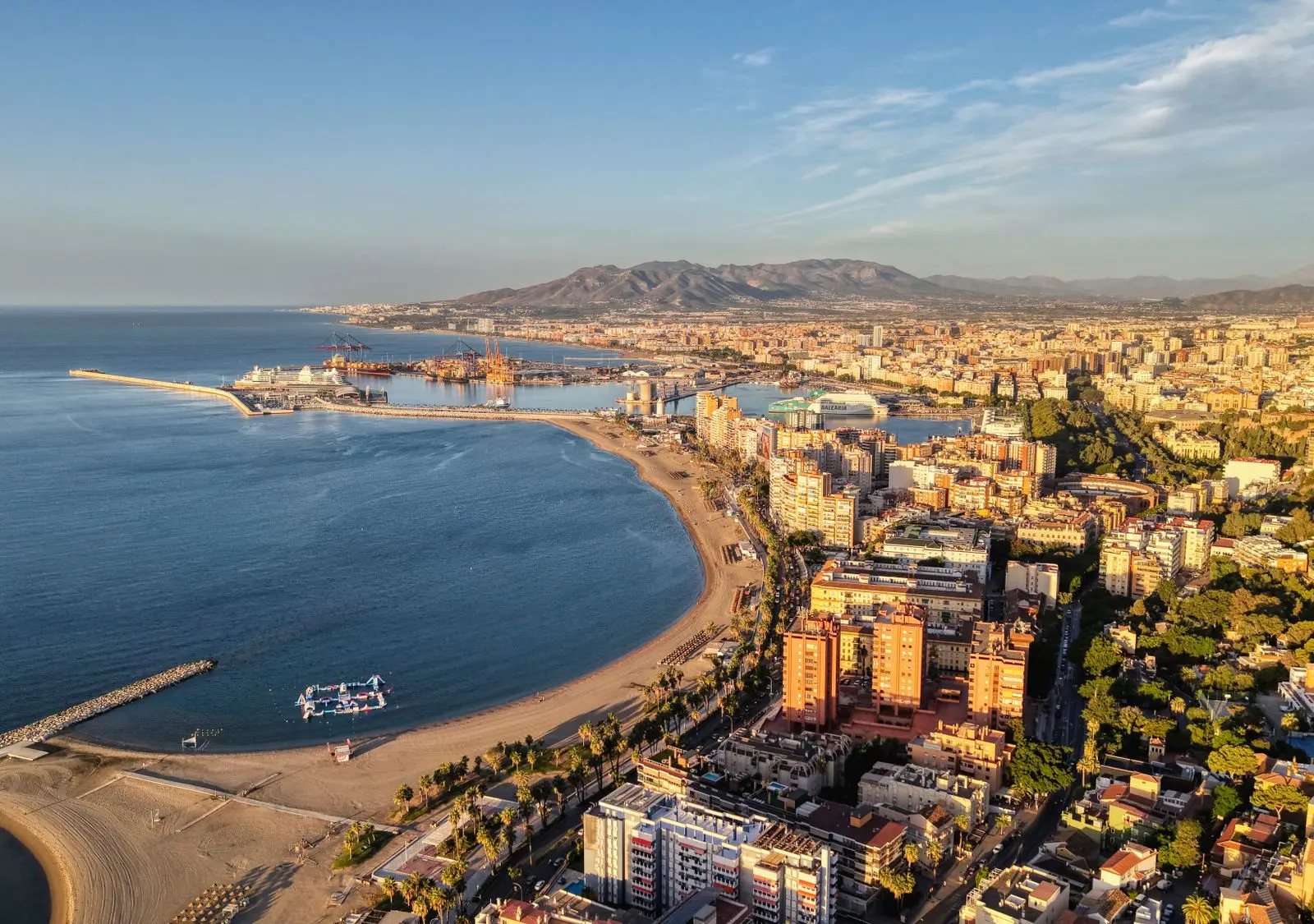
For years Málaga was just the airport you landed at on the way to the Costa del Sol beaches. Then the city decided it wanted to be a destination too, and it succeeded: it filled up with museums, renovated the port, restored the old town and is now one of Spain's liveliest cities. It has a Moorish fortress, a cathedral missing a tower, the house where Picasso was born and a beach ten minutes' walk from the cathedral. And sardines grilled on cane skewers over embers, inside boats on the sand.
The Alcazaba and Gibralfaro: Moorish Málaga
The Alcazaba is an eleventh-century Moorish fortress-palace built on the slope of the hill overlooking the city. Inside are courtyards with fountains, gardens, arches and walls on several levels, a taster of Granada's Alhambra with shorter queues.
At the foot of the Alcazaba is the Roman Theatre, discovered by chance in the twentieth century during building works. Roman ruins and a Moorish fortress side by side sum up Málaga's history nicely.
Higher up, the fourteenth-century Gibralfaro Castle offers the best view of the city: the port, the bullring, the cathedral and the sea. The walk up is steep but doable; there's also a bus. At sunset the view is worth every step.
The centre: the «one-armed» cathedral and Calle Larios
Málaga Cathedral is affectionately known as «La Manquita», the one-armed lady, because one of its two towers was never finished. The money, they say, went elsewhere. Inside it's Renaissance and imposing, and there are rooftop tours with views over the city.
Calle Larios, the main street, is elegant, pedestrian and always busy, especially at Christmas, when the lights turn it into a show. Around it, the old town has squares, churches, tapas bars and terraces.
The Atarazanas Market, in a former Arab shipyard with a huge stained-glass window, is the place to see fish, fruit and Andalusian produce and to snack at the counter. Go in the morning, and hungry.
Picasso and the city of museums
Pablo Picasso was born in Málaga in 1881, in a house on Plaza de la Merced that is now the Birthplace Museum, with personal items and works. Nearby, the Museo Picasso Málaga, in a Renaissance palace, holds an important collection donated by the artist's family.
Málaga has dozens of museums. The Centre Pompidou Málaga, in a colourful glass cube at the port, the Carmen Thyssen Museum, with nineteenth-century Spanish painting, and the Museum of Málaga, in the former Customs Palace, are the best known.
Even if museums aren't your thing, you'll enjoy Muelle Uno, the renovated harbour promenade, with shops, restaurants and views of the city and boats. It's the best late-afternoon stroll.
Beaches and espetos: seaside Málaga
Malagueta beach is a few minutes' walk from the centre, making Málaga one of the few big European cities with a real city beach. To the east come more beaches and the fishermen's quarter of Pedregalejo, with beach restaurants.
The espeto de sardinas is the coast's speciality: sardines skewered on a cane and grilled over embers inside small sand-filled boats by the sea. Add pescaíto frito (fried fish), ajoblanco, a cold almond and garlic soup, and a glass of sweet Málaga wine.
In the late afternoon the chiringuitos, the beach bars, fill with families and friends. Order a cold beer and some sardines, and let the sun set at its own pace.
Around Málaga: Ronda, Nerja and the Caminito del Rey
Ronda, about an hour and a half away, is a spectacular town over a gorge, with the Puente Nuevo linking both sides more than a hundred metres above the river and one of Spain's oldest bullrings.
Nerja, to the east, has the Balcón de Europa viewpoint and the huge Nerja caves full of stalactites. On the way are white villages like Frigiliana, one of the prettiest in Andalusia.
The Caminito del Rey is a walkway hanging from the walls of a gorge, once considered one of the world's most dangerous paths and now safe and very popular. You need to book in advance. A private tour helps you combine these places without rushing or unfamiliar roads.
A perfect day in Málaga
09:00
Gibralfaro
Climb to the castle for views over the city and port.
10:30
Alcazaba and Roman Theatre
Moorish courtyards, fountains and walls, with the Roman ruins below.
12:00
Cathedral and centre
La Manquita, Calle Larios and the Atarazanas Market.
14:00
Tapas lunch
Pescaíto frito and ajoblanco at a bar in the centre.
16:00
Picasso
The Picasso Museum and the Birthplace on Plaza de la Merced.
18:30
Muelle Uno and Malagueta
A harbour stroll and late afternoon on the beach.
21:00
Espetos at sunset
Grilled sardines at a chiringuito in Pedregalejo.
What it costs
Málaga is cheaper than Madrid or Barcelona, especially for food. Accommodation rises sharply in summer and Holy Week.
Budget
65–110 €
per person, per day
Hostel, tapas, the free city beach and museums on free-entry days.
Comfortable
140–240 €
per person, per day
Hotel in the centre, the Alcazaba, the Picasso Museum, a fish dinner and a trip to Ronda or Nerja.
No expense spared
350–700 €
per person, per day
Sea-view boutique hotel, chef-led restaurants and a private tour to the Caminito del Rey and Ronda.
Hostel bed
per night · More expensive in summer
25 € – 45 €
Mid-range hotel in the centre
per night, double room
80 € – 150 €
Boutique or sea-view hotel
per night, double room
180 € – 350 €
Alcazaba and Gibralfaro
per person · Combined ticket available
3 € – 10 €
Museo Picasso Málaga
per person
9 € – 14 €
Caminito del Rey ticket
per person · Booking required
8 € – 12 €
Tapas and a drink at lunch
per person
12 € – 20 €
Fish dinner with wine
per person
25 € – 45 €
Espetos and beer at a chiringuito
per person
15 € – 30 €
Approximate reference values for 2026. Always check before you go.
Tourist mistakes to avoid
- ✕Climbing to Gibralfaro at noon in August. The view is the same at nine in the morning; the heat isn't.
- ✕Going to the Caminito del Rey without a booking and expecting to get in.
- ✕Staying on the beach and never seeing the Alcazaba or the centre.
- ✕Ordering sangria everywhere. Try sweet Málaga wine or a tinto de verano.
- ✕Dining at seven and finding the restaurant empty. In Spain, dinner comes later.
- ✕Forgetting that during Holy Week processions close streets and accommodation sells out.
«In Málaga there's sun three hundred days a year. On the other sixty-five, there are sardines.»
More photos of Málaga
Frequently asked questions
How do I get from Lisbon to Málaga?
By plane, there are direct flights of about an hour and a half. By car it's about 650 km. You can also go by train via Madrid, with the high-speed train from Madrid to Málaga taking around two and a half hours.
How many days do I need in Málaga?
Two days are enough for the city. With three or four you can add trips to Ronda, Nerja or the Caminito del Rey.
Does Málaga have a city beach?
Yes. Malagueta beach is a few minutes' walk from the centre, and to the east there are more beaches and the old fishing quarter of Pedregalejo.
What is a sardine espeto?
Sardines skewered on a cane and grilled over embers inside small sand-filled boats on the beach. It's the most typical dish of the Málaga coast.
Do I need to book the Caminito del Rey?
Yes. Entries are limited and timed, and they sell out in advance, especially in spring and autumn.
Prices, opening hours and rules are approximate reference values and may change: always check before you go. Photos: Pexels.