How long
Two days for Palma and a day in the mountains. With a week, the whole of Mallorca shows its best.
Best time
May, June, September and October: warm sea, fewer people and friendlier prices. July and August are very busy.
Getting there (from Lisbon)
There are flights from Lisbon to Palma, direct in some seasons and via Madrid or Barcelona the rest of the year. The direct flight takes about two hours.
Ideal for
Couples, families, beach lovers, mountain hikers and fans of stone villages.
Don't forget
Book a car, transfer or tour in advance in summer. On the island, getting around decides the day.
Mallorca is known for crowded beaches and resorts, and parts of it are exactly that. But Palma, the capital, is an elegant, historic city dominated by a Gothic cathedral that seems to float over the sea. And the island hides a World Heritage mountain range, stone villages where Chopin and Robert Graves lived, a wooden train more than a century old and coves of water so clear the boats seem to hover. You just need to know where to go.
La Seu and the Almudaina Palace
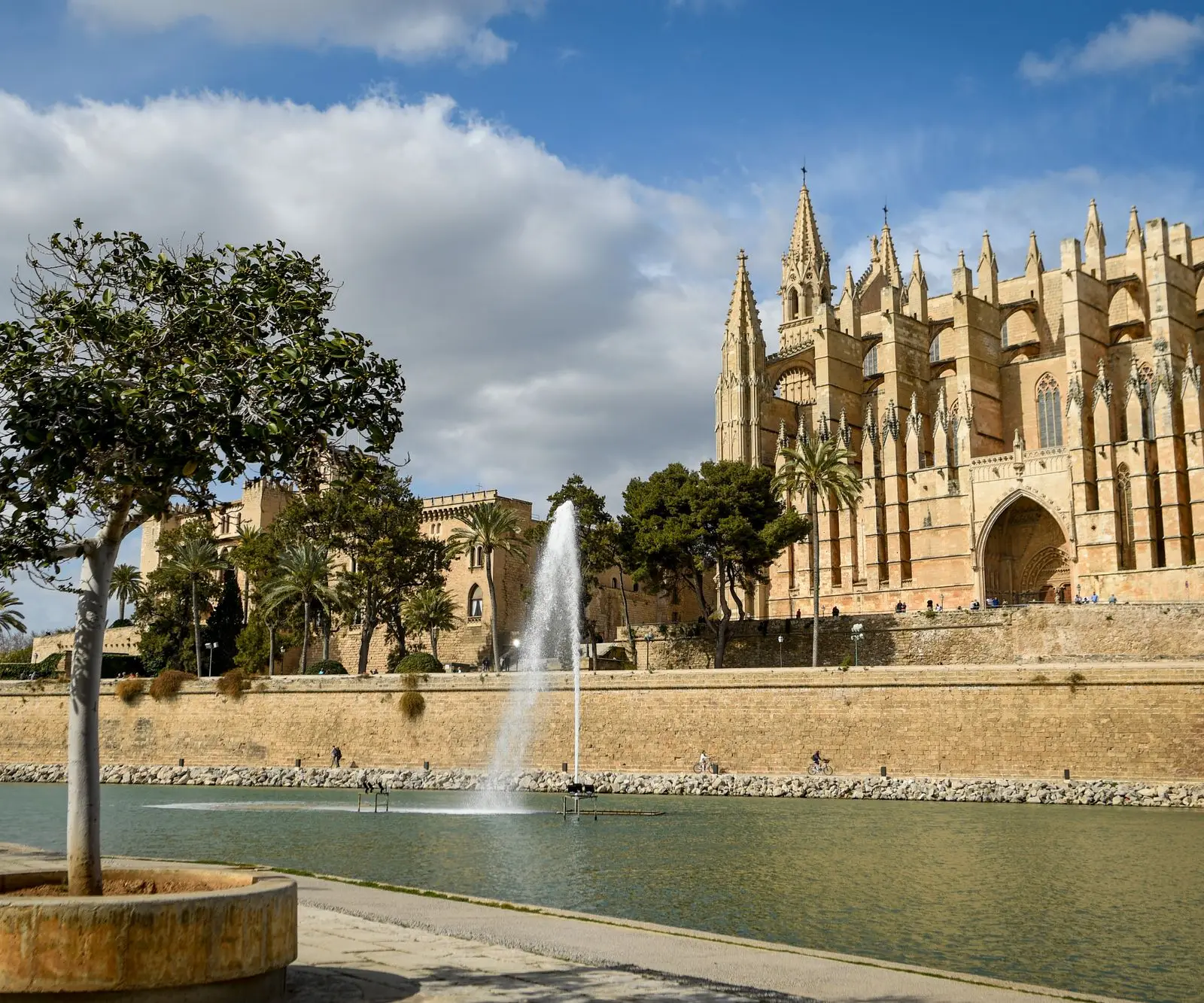
Palma Cathedral, known as La Seu, has stood by the sea since the Middle Ages, with enormous buttresses and one of the largest Gothic rose windows in the world. When sunlight comes through it, colours spread across the interior almost theatrically.
In the early twentieth century Antoni Gaudí worked on renovating the interior and left his touch, especially in the canopy suspended over the altar. More recently, Mallorcan artist Miquel Barceló covered a chapel in ceramics, a surprising contemporary work.
Right next door is the Royal Palace of La Almudaina, a former Arab fortress and residence of the kings of Mallorca, still used by the Spanish royal family for ceremonies. In front, the lake of the Parc de la Mar reflects the cathedral, and that's where Palma's most famous photo is taken.
The old town: patios, markets and ensaïmadas
Palma's centre is a maze of narrow streets, palaces with hidden patios, churches and squares. Many courtyards of old mansions can be glimpsed through open gates, and some are open to the public.
The Mercat de l'Olivar is the main market, with fish, meat, fruit and snack stalls. It's the ideal place to taste sobrassada, a soft, spicy pork sausage, and pa amb oli, bread with tomato, olive oil and whatever you like on top.
Mallorca's sweet is the ensaïmada, a spiral of light pastry dusted with icing sugar, plain or filled. It's sold in octagonal boxes that travellers carry onto the plane, and there's no shame in doing so.
Bellver Castle and the seafront
On a pine-covered hill a few kilometres from the centre stands Bellver Castle, a fourteenth-century Gothic castle that is rare for being circular. From the terrace, the view over the Bay of Palma, the port and the cathedral is magnificent.
The seafront promenade links the centre to the marina, with yachts of every size, and is great for walking or cycling in the late afternoon. In the other direction you reach city beaches and fishing quarters like Portitxol.
Santa Catalina, a former fishermen's quarter, now has a lively market, restaurants and bars. It's a good area for dinner and a night out.
The Tramuntana: Valldemossa, Deià and Sóller
The Serra de Tramuntana, running along the northwest coast, has been a UNESCO World Heritage Site since 2011 for its landscape of terraces, olive groves and stone villages shaped over centuries. Its mountain roads, winding above the sea, are among the most beautiful in the Mediterranean.
Valldemossa is a stone village where Chopin and the writer George Sand spent a winter in the old charterhouse. Deià, further on, is a hillside village where poet Robert Graves lived, with stone houses and orange trees.
Sóller is reached on the famous wooden train that has left Palma since the early twentieth century, crossing the mountains through tunnels and valleys. In Sóller, a vintage tram runs to the port. A private tour lets you combine Valldemossa, Deià and Sóller in one day without mountain-road stress.
Coves and beaches: turquoise Mallorca
Mallorca's calas, small coves between rocks and pines, are the island's great postcard. Caló des Moro in the southeast is one of the most photographed, with turquoise water and access on foot. There are dozens of others, more or less hidden, along the coast.
If you prefer big beaches, Es Trenc in the south is long and natural, with Caribbean-coloured water. In the north, Cap de Formentor has spectacular viewpoints over the sea.
In summer the most famous coves fill up early and parking is limited. An excellent option is to see the coast by boat: some trips stop at coves reachable only by sea.
A perfect day in Palma
09:30
La Seu
The rose window, Gaudí's canopy and Barceló's chapel.
11:00
Almudaina and Parc de la Mar
The palace and the photo of the cathedral reflected in the lake.
13:00
Old town
Hidden patios, churches and an ensaïmada with coffee.
14:30
Mercat de l'Olivar
A tapas lunch: sobrassada, pa amb oli and Mahón cheese.
16:30
Bellver Castle
The round castle and the view over the whole bay.
18:30
Seafront
From the marina to Portitxol in the late afternoon.
21:00
Dinner in Santa Catalina
Fish, arroz brut or tapas in the old fishermen's quarter.
What it costs
Mallorca can be very expensive in summer, especially for accommodation. Outside July and August prices drop considerably.
Budget
80–130 €
per person, per day
Hostel, the market, the cathedral, Bellver and public beaches, with public transport and lots of patience.
Comfortable
180–320 €
per person, per day
Hotel in Palma, the Sóller train, a boat trip and dinners with wine.
No expense spared
450–900 €
per person, per day
Boutique hotel in the mountains, a private boat to the coves and a private Tramuntana tour.
Hostel bed
per night · Much more expensive in August
30 € – 55 €
Mid-range hotel in Palma
per night, double room
100 € – 190 €
Boutique or mountain hotel
per night, double room
220 € – 450 €
Palma Cathedral
per person
8 € – 12 €
Bellver Castle
per person
4 € – 8 €
Sóller train
per person, one way
25 € – 35 €
Menu of the day at lunch
per meal
15 € – 25 €
Dinner with wine
per person
30 € – 60 €
Boat trip to the coves
per person
60 € – 150 €
Approximate reference values for 2026. Always check before you go.
Tourist mistakes to avoid
- ✕Staying on the resort beaches and thinking that's all Mallorca is.
- ✕Going to the famous coves at noon in August and expecting to park.
- ✕Driving the Tramuntana in a hurry. The roads are narrow, winding and full of cyclists.
- ✕Forgetting to book the Sóller train in high season.
- ✕Leaving Palma without trying ensaïmada and sobrassada.
- ✕Visiting the cathedral without looking at the rose window in late morning, when the sun comes through.
«Mallorca has two islands: the one of towels and the one of mountains. The second is the one you keep in your heart.»
More photos of Palma de Mallorca
Frequently asked questions
How do I get from Lisbon to Palma de Mallorca?
By plane. There are direct flights in some seasons, taking about two hours, and connections via Madrid or Barcelona the rest of the year.
How many days do I need in Mallorca?
Two days for Palma and around. With four to seven days you can add the Tramuntana mountains, the coves and the north of the island.
What is the Sóller train?
A historic wooden train linking Palma and Sóller since the early twentieth century, crossing the Tramuntana through tunnels and valleys. In Sóller, a vintage tram goes down to the port.
What are the best beaches in Mallorca?
The southeastern coves such as Caló des Moro, Es Trenc beach in the south and the northern coves near Formentor. Many are best seen by boat.
What should I eat in Mallorca?
Ensaïmada, sobrassada, pa amb oli, arroz brut and fresh fish. To take home, a box of ensaïmadas is the classic souvenir.
Prices, opening hours and rules are approximate reference values and may change: always check before you go. Photos: Pexels.