How long
Two or three days. One for the city and beaches, another for eating, and a third for the surrounding coast.
Best time
June to September for the beach; September brings the Film Festival. In spring and autumn you eat just as well, with fewer people.
Getting there (from Lisbon)
The easiest option is to fly from Lisbon to Bilbao and continue by car or bus, about an hour and a quarter. By car from Lisbon it's about 900 km.
Ideal for
Food lovers of every kind, fans of city beaches, surfers and people who plan trips around restaurants.
Don't forget
A light raincoat. The Basque Country is green for a reason, and rain arrives without asking.
San Sebastián, or Donostia in Basque, is an elegant city set in a shell-shaped bay, with a city beach many consider the most beautiful in Europe. It was the summer resort of Spanish royalty, has Belle Époque buildings and a seafront promenade with white balustrades. But what brings half the world here is the food: there are more Michelin stars per head than almost anywhere else, and the counters of the Old Town bars are covered in pintxos. You come for the view. You stay for your stomach.
La Concha and Ondarreta: the shell-shaped bay
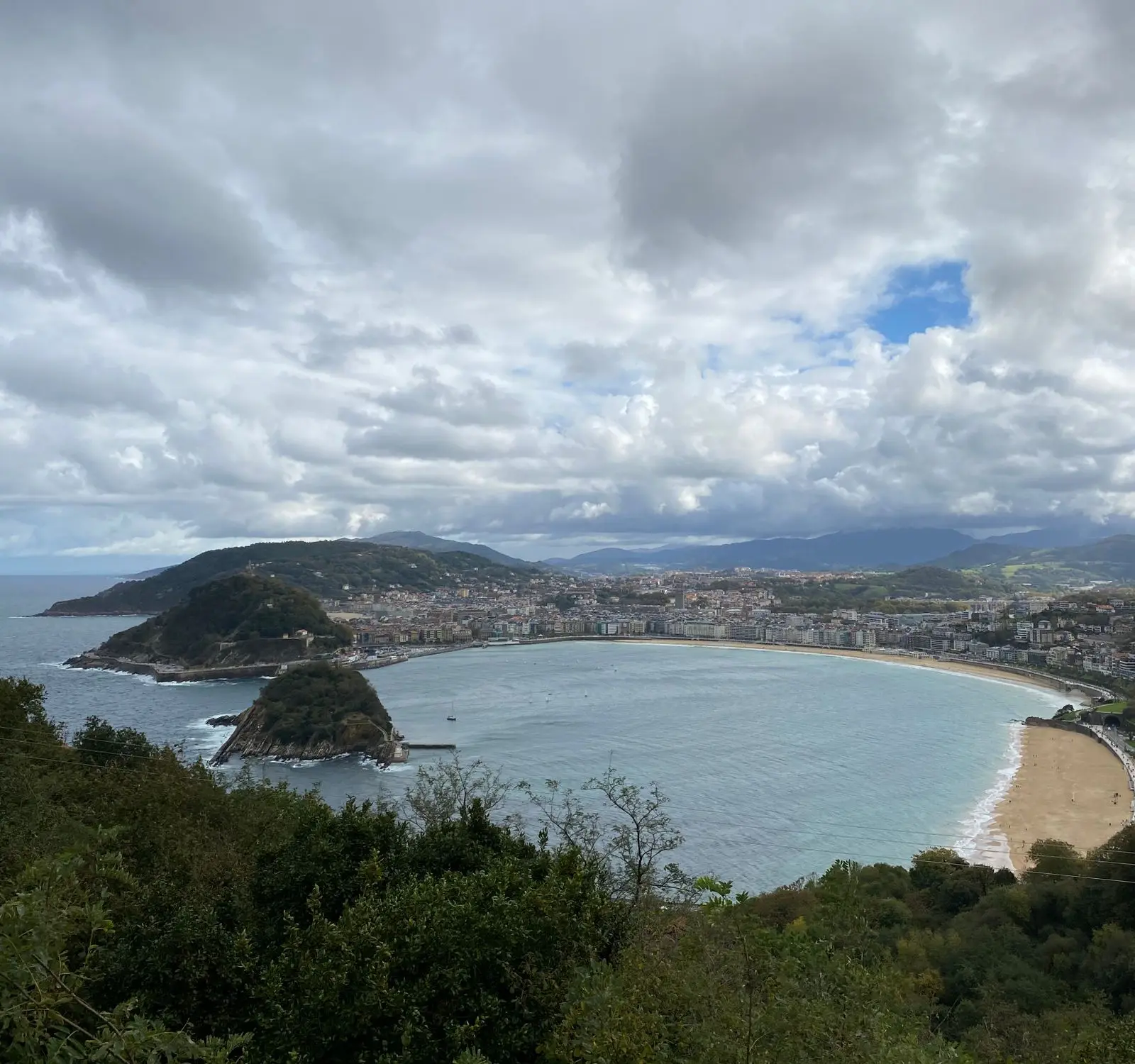
La Concha beach curves in a half-moon along the bay, with golden sand, calm water and Santa Clara island in the middle, as if someone placed it there for the photo. The promenade, with its white balustrades and old lamps, is perfect for a walk at any hour.
At the western end, Ondarreta beach is more family-oriented and quiet. Beyond it, on the rocks, is the Comb of the Wind, a set of iron sculptures by Eduardo Chillida anchored in the rocks and battered by waves. On rough days, water bursts from holes in the ground like geysers.
In summer, boats run to Santa Clara island, with a small bar and a hidden beach. Swimming in the bay with the city in front of you is one of the best feelings of the trip.
The Old Town and its pintxos
The Parte Vieja, the Old Town, is a maze of narrow streets between the port and Mount Urgull, with the Basilica of Santa María del Coro and Plaza de la Constitución, a former bullring that still has numbered balconies.
But the real monument is the pintxo bars. Counters are covered with small edible works of art: bread with salt cod, mushrooms, anchovies, ham, octopus and the gilda, a skewer of olive, anchovy and chilli born here. Besides those on display, each bar has hot pintxos made to order, listed on boards on the wall.
The rule is simple: one or two pintxos and a drink in each bar, then move on. To drink, order txakoli, a slightly sparkling Basque white wine poured from a height into the glass, or cider. And save room for a slice of the famous Basque cheesecake, burnt outside and creamy inside.
The hills: Igueldo and Urgull
At the western end of the bay, Mount Igueldo has a wooden funicular over a century old that climbs to the top. Up there is San Sebastián's most famous view, the whole bay curving like a shell, and an old amusement park with a vintage roller coaster that thrills more through nostalgia than speed.
On the other side, above the Old Town, Mount Urgull is climbed on foot along shady paths. At the top are the Castle of La Mota and a large Sacred Heart statue watching over the city. The views over the bay and sea are fantastic, and the walk is peaceful.
In the late afternoon, either is perfect for watching the sun go down over the bay and the city lights come on.
Gros and Zurriola: the surf side
Across the Urumea river is the Gros neighbourhood, more relaxed and youthful, with Zurriola beach facing the open sea and its regular waves. It's the beach of surfers, surf schools and those who prefer a more informal atmosphere.
Next to the beach are the Kursaal buildings, two glass cubes designed by architect Rafael Moneo, which host the San Sebastián Film Festival every September. At that time the city fills with film stars and fans looking for them.
Gros also has many pintxo bars, sometimes more modern and less touristy than in the Old Town. It's a good alternative for your second night.
Around: Getaria, Hondarribia and Biarritz
The Basque coast around San Sebastián is very beautiful. Getaria, about half an hour away, is a fishing village famous for grilled fish, seaside txakoli vineyards and the Cristóbal Balenciaga Museum, dedicated to the couturier born there.
Hondarribia, by the French border, has a walled medieval centre and a fishermen's quarter with colourful houses and wooden balconies. Pasaia, closer by, is a port tucked between hills where Victor Hugo once lived for a while.
Biarritz, already in France, is less than an hour away: an elegant resort, surf waves and another food culture. A private tour lets you combine the Spanish and French Basque coast on the same day.
A perfect day in San Sebastián
09:00
Stroll along La Concha
Coffee and a walk along the promenade to the Comb of the Wind.
10:30
Mount Igueldo
The century-old funicular and the bay's most famous view.
12:30
Old Town
Santa María del Coro, Plaza de la Constitución and your first pintxos.
15:00
Beach
An afternoon at La Concha or Ondarreta, swim included.
17:00
Mount Urgull
A walk up to the castle and statue, with sea views.
19:00
Gros and Zurriola
Surfers at the end of the day and the Kursaal by the sea.
21:30
Pintxo crawl
Bar by bar in the Old Town, with txakoli and Basque cheesecake to finish.
What it costs
San Sebastián is one of Spain's most expensive cities to sleep in. Eating pintxos, luckily, is still affordable.
Budget
90–150 €
per person, per day
Hostel, pintxos instead of dinner, beaches and hills on foot. The bay view costs nothing.
Comfortable
200–350 €
per person, per day
Hotel in the centre, a pintxo crawl with txakoli, the Igueldo funicular and dinner at a traditional restaurant.
No expense spared
500–1000 €
per person, per day
Bay-view hotel, Michelin-starred tasting menu and a private tour of the Basque coast to Biarritz.
Hostel bed
per night · Much more expensive in August and during the festival
35 € – 60 €
Mid-range hotel
per night, double room
120 € – 220 €
Luxury hotel on the bay
per night, double room
250 € – 500 €
Pintxo
each · Hot ones cost a little more
3 € – 6 €
Glass of txakoli or cider
per glass
3 € – 5 €
Full pintxo crawl
per person, with drinks
25 € – 45 €
Michelin-starred tasting menu
per person, without wine
150 € – 350 €
Dinner at a traditional restaurant
per person
35 € – 60 €
Meal at a cider house
per person · During txotx season, January to April
40 € – 70 €
Approximate reference values for 2026. Always check before you go.
Tourist mistakes to avoid
- ✕Ordering all your pintxos at once in the same bar. The fun is in moving on.
- ✕Turning up at a starred restaurant without a booking.
- ✕Ignoring the hot pintxos on the board. They're often the best.
- ✕Coming in August without booking accommodation well in advance.
- ✕Leaving your raincoat at the hotel because «it's sunny». In San Sebastián that changes in minutes.
- ✕Calling pintxos «tapas» out loud. Basques will correct you, always kindly, but they will.
«In San Sebastián nobody has dinner. You go from bar to bar until you're no longer hungry, which never happens.»
More photos of San Sebastián
Frequently asked questions
How do I get from Lisbon to San Sebastián?
The easiest option is to fly to Bilbao and continue by car or bus, about an hour and a quarter. San Sebastián also has a small airport with few connections. By car from Lisbon it's about 900 km.
What are pintxos?
Small bites served at the counter of Basque bars, often on bread. You eat one or two in each bar with a drink, then move to another bar.
What is the best beach in San Sebastián?
La Concha is the most famous and beautiful; Ondarreta is quieter and family-friendly; Zurriola, in Gros, is the surf beach.
When is the San Sebastián Film Festival?
Every September, at the Kursaal and other venues. Accommodation fills up and prices rise at that time.
Can I go from San Sebastián to France?
Yes. The border is about 20 km away, and Biarritz less than an hour. A private tour lets you combine the Spanish and French Basque coast on the same day.
Prices, opening hours and rules are approximate reference values and may change: always check before you go. Photos: Pexels.