How long
One day covers the essentials. Staying overnight lets you see the city lit up and without groups.
Best time
Spring and autumn. In summer the heat is strong and the stone streets heat up like an oven.
Getting there (from Madrid)
The high-speed train links Madrid and Toledo in about half an hour. From Lisbon, the easiest option is to fly to Madrid. By car from Lisbon it's about 600 km.
Ideal for
Lovers of history, art and medieval cities, and anyone who enjoys climbing up and down narrow streets.
Don't forget
Comfortable shoes: Toledo is all ups, downs and uneven stone.
Toledo is a whole city perched on a rock, wrapped in a bend of the Tagus, the same river that later reaches Lisbon. It was the Visigothic capital, a Muslim city, residence of the kings of Castile and home to Christians, Jews and Muslims for centuries. Today it's a UNESCO World Heritage Site and feels like an open-air museum, with a giant cathedral, synagogues, a little mosque and the paintings of El Greco. And it smells of marzipan on every corner.
The valley view: Toledo from outside
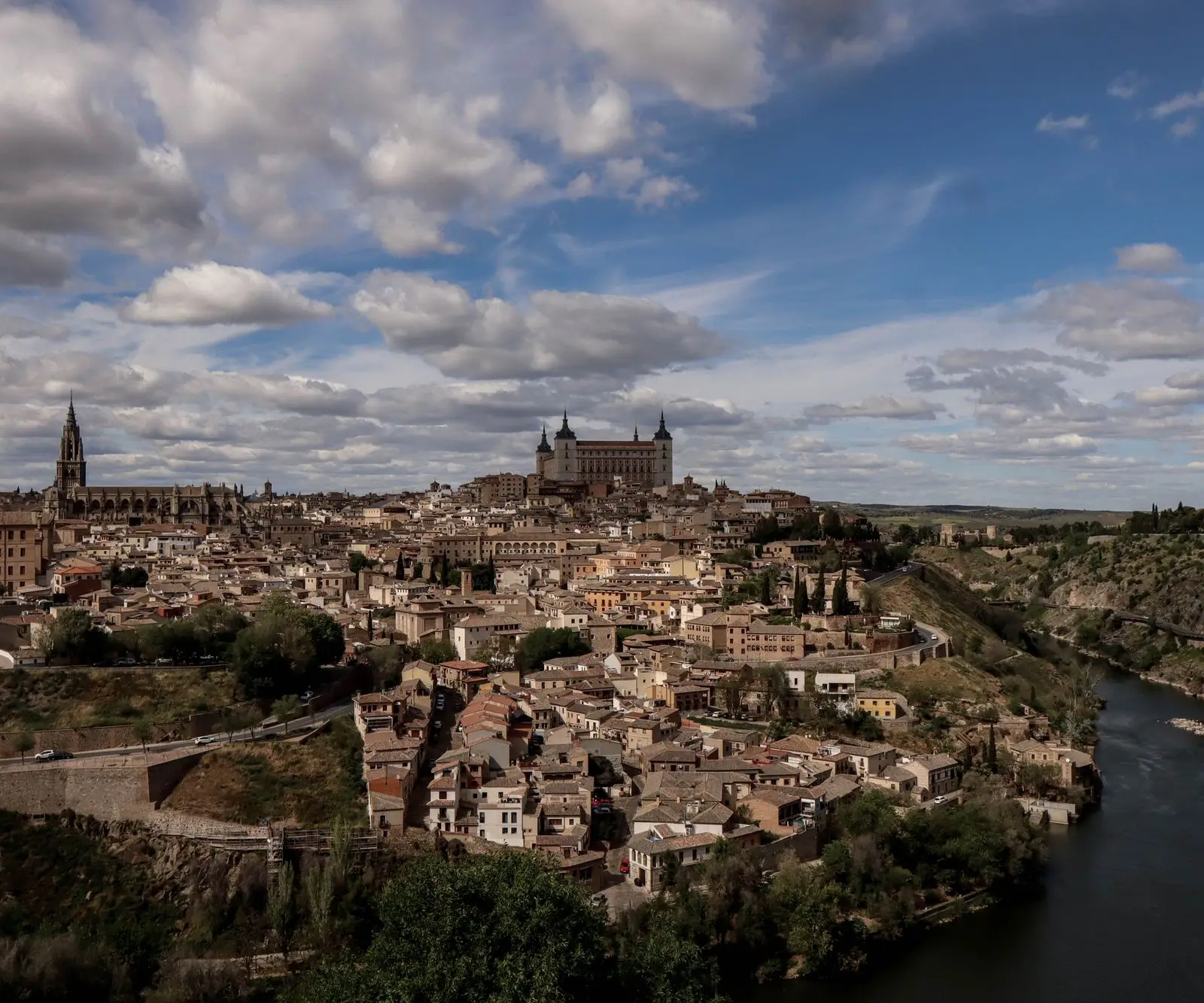
The best way to start is to see Toledo from outside. From the Mirador del Valle, across the Tagus, the whole city appears on its rock, with the cathedral and the Alcázar dominating the skyline. It's the view El Greco painted, and it still stops traffic.
The scenic road that circles the city along the south bank has several viewpoints and is perfect in the late afternoon, when the stone turns golden. The medieval Alcántara and San Martín bridges, at either end, are monumental gateways to the city.
To get up to the old town from the lower part, there are public escalators that save the steepest bit. Use them without shame: locals do too.
The Primate Cathedral
Toledo Cathedral is one of the largest Gothic cathedrals in Spain and the seat of the primate archbishop. Built between the thirteenth and fifteenth centuries, it has an almost excessive richness inside: chapels, grilles, a carved wooden choir, stained glass and a treasury with an enormous gold and silver monstrance.
El Transparente is one of the most surprising works: a baroque altar lit through an opening in the ceiling that lets sunlight fall directly on marble sculptures. The sacristy is a real art gallery, with several paintings by El Greco, Goya and other masters.
Allow at least an hour and a half. It's easy to underestimate the size and leave feeling you've seen only half.
The city of three cultures
For centuries, Christians, Jews and Muslims lived side by side in Toledo, and the city bears the marks of all three religions. The Mosque of Cristo de la Luz, from the year 999, is small but precious, with horseshoe arches and brick domes.
The Synagogue of Santa María la Blanca impresses with its white columns and horseshoe arches, which look more like a mosque than a synagogue. The Synagogue of El Tránsito, with its decorated wooden ceiling, houses the Sephardic Museum on the history of Jews in Spain.
The Monastery of San Juan de los Reyes, built by the Catholic Monarchs, has a beautiful Gothic cloister. Walking among these monuments through the old Jewish quarter is one of the best ways to understand the complex history of the Iberian Peninsula.
El Greco: the painter who chose Toledo
Doménikos Theotokópoulos was born in Crete, passed through Venice and Rome and settled in Toledo in the sixteenth century, where he lived until his death. He became known as El Greco, and his elongated figures and intense colours are unmistakable today.
His most famous work, «The Burial of the Count of Orgaz», hangs in the Church of Santo Tomé, the place it was painted for. It's a huge canvas showing heaven and earth at once, and well worth the short queue.
The El Greco Museum shows other works and recreates the atmosphere of the time. There are also paintings of his in the cathedral and other churches. In Toledo, El Greco isn't in a museum: he's everywhere.
The Alcázar, swords and marzipan
At the highest point of the city stands the Alcázar, a square fortress that was once a royal palace and is now the Army Museum, with a fantastic view from the terrace. It was heavily damaged during the Civil War and rebuilt afterwards.
Toledo has been famous for centuries for its steel swords, and there are still workshops and shops selling swords, knives and damascene pieces, a technique of inlaying gold and silver into metal. If you buy a sword, check your airline's rules before packing it.
Toledo's sweet is marzipan, made of almond and sugar in little figures, sold by convents and traditional pastry shops all over town. For a meal, try carcamusas, a meat stew with tomato, stewed partridge and Manchego cheese.
A perfect day in Toledo
09:30
Mirador del Valle
The whole of Toledo across the Tagus, in the best morning light.
10:00
Primate Cathedral
El Transparente, the sacristy with El Greco and the treasury.
11:30
Santo Tomé
«The Burial of the Count of Orgaz», where it was painted to hang.
13:30
Lunch
Carcamusas, stewed partridge or Manchego cheese with wine.
15:30
Jewish quarter
The Santa María la Blanca and El Tránsito synagogues and San Juan de los Reyes.
17:00
Alcázar
The terrace with a view and a look at the Army Museum.
19:00
Marzipan and home
A box of marzipan for the journey and back to Madrid in the late afternoon.
What it costs
Toledo is an affordable day trip. A tourist wristband gives entry to several monuments and can be worth it.
Budget
50–90 €
per person, per day
Train from Madrid, the cathedral, one or two synagogues, a menu of the day and free viewpoints.
Comfortable
120–200 €
per person, per day
Hotel in the centre, the tourist wristband, dinner with wine and an evening stroll.
No expense spared
280–550 €
per person, per day
Parador overlooking the city, chef-led restaurants and a private tour from Madrid.
Mid-range hotel in the centre
per night, double room
70 € – 130 €
Hotel with a view or parador
per night, double room
150 € – 280 €
Cathedral
per person
10 € – 15 €
Synagogues, mosque or Santo Tomé
per person, each · The tourist wristband groups several
3 € – 6 €
Menu of the day at lunch
per meal
12 € – 20 €
Dinner with wine
per person
25 € – 45 €
Box of marzipan
per small box
4 € – 10 €
Madrid–Toledo high-speed train
per person, one way
12 € – 25 €
Approximate reference values for 2026. Always check before you go.
Tourist mistakes to avoid
- ✕Seeing Toledo only from inside and never from the Mirador del Valle.
- ✕Going into the cathedral short on time. It's huge and deserves calm.
- ✕Walking the steep stone streets in smooth sandals.
- ✕Visiting at noon in August and deciding Toledo is nothing but heat.
- ✕Buying a sword without knowing how you'll transport it.
- ✕Leaving without trying marzipan. That would be almost a local crime.
«In Toledo, even the stones have three religions and two opinions.»
More photos of Toledo
Frequently asked questions
How do I get from Madrid to Toledo?
The high-speed train takes about half an hour. There are also buses, taking about an hour. A private tour from Madrid lets you start at the Mirador del Valle.
How do I get from Lisbon to Toledo?
The easiest option is to fly from Lisbon to Madrid and continue by train. By car it's about 600 km.
How long do I need to visit Toledo?
One day is enough for the cathedral, the synagogues, Santo Tomé and the Alcázar. Staying a night lets you see the city lit up and without crowds.
Where can I see the Count of Orgaz painting?
In the Church of Santo Tomé in Toledo, where El Greco painted it in the sixteenth century. It's his most famous work.
What should I buy in Toledo?
Marzipan, damascene pieces and, if you like, swords or knives of Toledo steel. Check transport rules before buying bladed items.
Prices, opening hours and rules are approximate reference values and may change: always check before you go. Photos: Pexels.