How long
Two to three days for the city, the beach and the Albufera. With more time, there's a lot to discover around it.
Best time
Spring and autumn. In March come the Fallas, a huge festival with monuments that burn; in summer, heat and beach.
Getting there (from Lisbon)
There are direct flights from Lisbon of about an hour and forty minutes. From Madrid, the high-speed train takes about an hour and forty minutes.
Ideal for
Families, architecture lovers, cyclists and anyone who goes to Spain for the paella.
Don't forget
A rental bike: Valencia is flat and has cycle lanes everywhere.
Valencia is the city that took a river that flooded everything, diverted it, and turned the old riverbed into a nine-kilometre garden. At the end of that garden it built buildings that look like spaceships, and at the start it kept a Gothic old town with a chalice said to be the Holy Grail. It has wide city beaches, a breathtaking market and is the home of paella, which Valencians defend with a passion that doesn't allow chorizo. Don't even think about it.
The City of Arts and Sciences
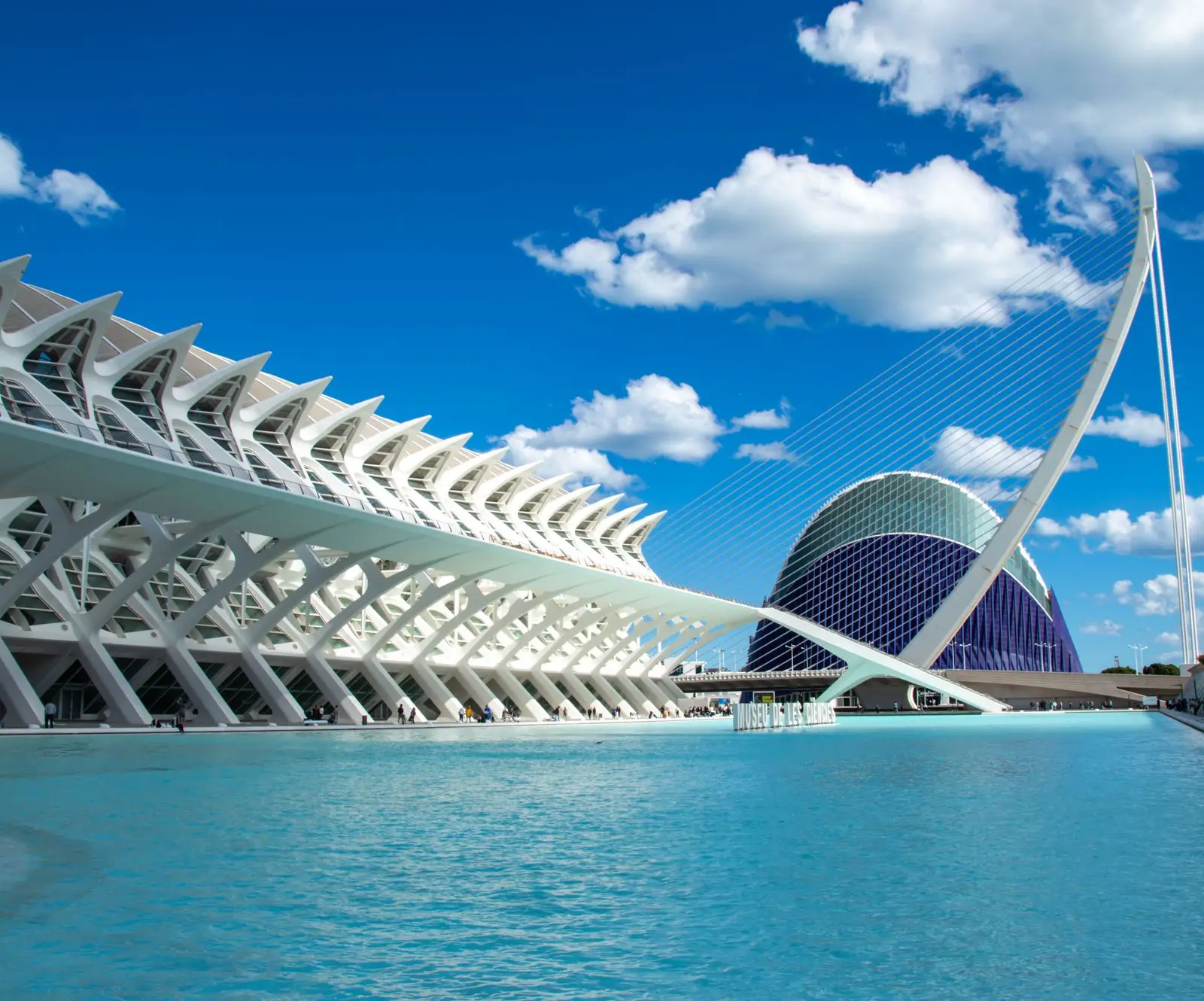
At the end of the old riverbed stands the City of Arts and Sciences, a complex of futuristic buildings designed mostly by Valencian architect Santiago Calatrava. White, curved and surrounded by blue pools, they look like something from a science-fiction film.
The eye-shaped Hemisfèric houses an IMAX cinema; the Science Museum is interactive and great for children; the Palau de les Arts hosts opera and concerts. The Oceanogràfic is one of Europe's largest aquariums, with sharks, dolphins and belugas.
Even without going inside, it's worth walking around, especially in the late afternoon and at night when the lights reflect in the water. It's the most famous image of modern Valencia.
The old town: cathedral, Grail and El Carmen
Valencia Cathedral mixes Romanesque, Gothic and baroque styles and keeps, in one chapel, an ancient chalice that tradition identifies as the Holy Grail. Next door, the Miguelete tower offers, after many steps, a view over the rooftops and the city's blue domes.
El Carmen is the bohemian heart of the centre, with narrow streets, street art, bars and terraces. Nearby are the Serranos Towers and the Quart Towers, old gates of the medieval wall.
Plaza de la Virgen and Plaza de la Reina are the main meeting points. In March, during the Fallas, they fill with flowers, music, gunpowder and giant monuments of cardboard and wood that burn on the final night.
The Silk Exchange and the Central Market
The fifteenth-century Silk Exchange, La Lonja, is one of the most beautiful Gothic civic buildings in Europe and a UNESCO World Heritage Site. The hall of columns, with spiral pillars opening like palm trees on the ceiling, was where merchants did business.
Right opposite is the Central Market, one of Europe's largest covered markets, in modernist style with domes, stained glass and tiles. Inside are hundreds of stalls of fruit, fish, ham, spices and rice.
Go in the morning, hungry, and order something to taste at the counter. Nearby, try horchata, a cool tiger-nut drink, with fartons, long sweet buns made for dipping.
The Turia gardens and the beaches
After a great flood in 1957, the Turia river was diverted around the city, and the old bed became a continuous park about nine kilometres long. It has lawns, sports grounds, fountains, old bridges and cycle paths, and crosses the city from end to end.
Renting a bike and riding the Turia to the City of Arts and Sciences is one of the best ways to see Valencia. The city is flat, the cycle lanes are good and the climate helps almost all year.
Valencia has wide, fine-sand city beaches, such as Malvarrosa and Las Arenas, a short distance from the centre. Along the seafront promenade there are rice restaurants and bars for the sunset.
Paella and the Albufera
Paella was born on the outskirts of Valencia, and here it's serious business. Traditional paella valenciana has chicken, rabbit, green beans, garrofó (a large white bean), saffron and local rice, cooked in a wide pan over a fire. Seafood is a different paella; chorizo, never.
The best place to try it is the Albufera, a nature park south of the city with a large lagoon surrounded by rice fields. In the village of El Palmar there are paella restaurants and boat trips on the lagoon at sunset, with herons and fishermen.
A local rule: paella is eaten at lunch, not dinner. And the toasted layer at the bottom, the socarrat, is the most fought-over part of the table. Order yours ahead; it takes time.
A perfect day in Valencia
09:00
Central Market
Breakfast at the counter among fruit, ham and spices.
10:30
Silk Exchange and cathedral
The spiral columns, the Holy Grail and the climb up the Miguelete.
12:00
El Carmen
Narrow streets, street art and the Serranos Towers.
14:00
Paella in the Albufera
Paella valenciana for lunch in El Palmar.
16:30
Boat on the lagoon
A ride around the Albufera among rice fields and herons.
18:30
Turia by bike
From the centre to the City of Arts, with sunset on the pools.
21:00
Tapas dinner
Esgarraet, clóchinas mussels in summer and an Agua de Valencia to toast.
What it costs
Valencia is one of the most affordable big Spanish cities. What weighs most are Oceanogràfic tickets and paella restaurants with a view.
Budget
65–110 €
per person, per day
Hostel, menu of the day, a bike in the Turia, free beaches and an evening horchata.
Comfortable
140–240 €
per person, per day
Hotel in the centre, the Oceanogràfic or Science Museum, paella in the Albufera and a boat trip.
No expense spared
330–650 €
per person, per day
Beach or boutique hotel, chef-led restaurants and private transport to the Albufera and around.
Hostel bed
per night · More expensive during the Fallas
25 € – 45 €
Mid-range hotel in the centre
per night, double room
80 € – 150 €
Boutique or beach hotel
per night, double room
170 € – 320 €
City of Arts tickets
per person · The Oceanogràfic is the priciest
10 € – 40 €
Horchata with fartons
per person
3 € – 6 €
Miguelete climb
per person
3 € – 6 €
Menu of the day at lunch
per meal
12 € – 20 €
Paella with a drink
per person · Usually for two or more
25 € – 45 €
Boat trip in the Albufera
per person
20 € – 35 €
Approximate reference values for 2026. Always check before you go.
Tourist mistakes to avoid
- ✕Ordering paella for dinner at a tourist restaurant and thinking it's the real thing.
- ✕Putting chorizo in paella, even in your thoughts.
- ✕Coming during the Fallas without booked accommodation and expecting quiet nights.
- ✕Staying at the City of Arts and never seeing the old town.
- ✕Cycling off the bike lanes in the centre. There are plenty; use them.
- ✕Going to the Albufera at Sunday lunchtime without a booking.
«In Valencia people argue about politics, football and paella. Only the first two allow opinions.»
More photos of Valencia
Frequently asked questions
How do I get from Lisbon to Valencia?
By plane, there are direct flights of about an hour and forty minutes. You can also go via Madrid and take the high-speed train, which takes about an hour and forty minutes.
What is the City of Arts and Sciences?
A complex of futuristic buildings in the old Turia riverbed, designed mostly by Santiago Calatrava, with a science museum, IMAX cinema, opera house and one of Europe's largest aquariums.
Where can I eat the best paella in Valencia?
In the Albufera, especially the village of El Palmar, surrounded by rice fields. Traditional paella valenciana has chicken, rabbit, green beans and garrofó beans, and is eaten at lunch.
When are the Fallas?
In March, peaking between the 15th and 19th. Giant monuments fill the streets and burn on the last night. It's a spectacular festival, but very loud and crowded.
Does Valencia have beaches?
Yes. Malvarrosa and Las Arenas beaches are a short distance from the centre, wide and fine-sanded, with a seafront promenade and restaurants.
Prices, opening hours and rules are approximate reference values and may change: always check before you go. Photos: Pexels.