How long
2 to 4 days. In a single day you'll see the essentials, but running and climbing.
Best time
April to June and September to October. June brings the Santos Populares festivals, sardines and very little sleep.
Getting there (from Lisbon)
Humberto Delgado airport is about 7 km from the centre: 25 to 35 minutes by metro (red line, with a change) or 15 to 25 minutes by taxi or transfer, traffic permitting.
Ideal for
Couples, groups of friends, food lovers, sunset photographers and legs that are up for some work.
Don't forget
Shoes with a good grip, a light jacket for the river breeze in the evening and room in your stomach for one more pastel.
Lisbon is built on hills, and each one makes sure you've earned the next pastel de nata. It's a city where the trams creak, laundry dries in windows above 500-year-old monuments and the sunset is treated as serious business. You'll climb more than you planned, eat more than you'll admit and go home saying «obrigado» with an accent. Put on good shoes and come along.
Baixa and Praça do Comércio: the flat bit (enjoy it while it lasts)
In 1755 an earthquake, followed by a tsunami and fires, flattened central Lisbon. The Marquis of Pombal had the Baixa rebuilt on a grid: straight streets, matching buildings and an inner wooden frame, the so-called Pombaline cage, designed to withstand the next shake. The result is the only part of town where you can walk without your calves filing a complaint.
Praça do Comércio opens straight onto the Tagus, with yellow arcades, the equestrian statue of King José I in the middle and the Rua Augusta Arch acting as the city's front door. You can climb to the top of the arch to see the square from above. Next to it, the Cais das Colunas has steps leading down into the water: sit there in the late afternoon and you'll understand why Lisboetas talk about the river as if it were family.
Rua Augusta is pedestrianised and leads to Rossio, whose black-and-white wave-patterned paving makes half the world seasick in photos. Look out for the Dona Maria II National Theatre and the façade of Rossio station, with its horseshoe-shaped doors. Right next door is Largo de São Domingos, where ginjinha is drunk standing up at the counter.
Two warnings from someone who has seen it all. First: on Rua Augusta, be wary of restaurants with laminated menus full of photos and a waiter at the door calling you like a long-lost cousin. Second: the gentlemen whispering offers of illicit substances usually sell pressed bay leaves. A firm «não, obrigado» and keep walking.
Alfama and the Castle: getting lost is part of the plan
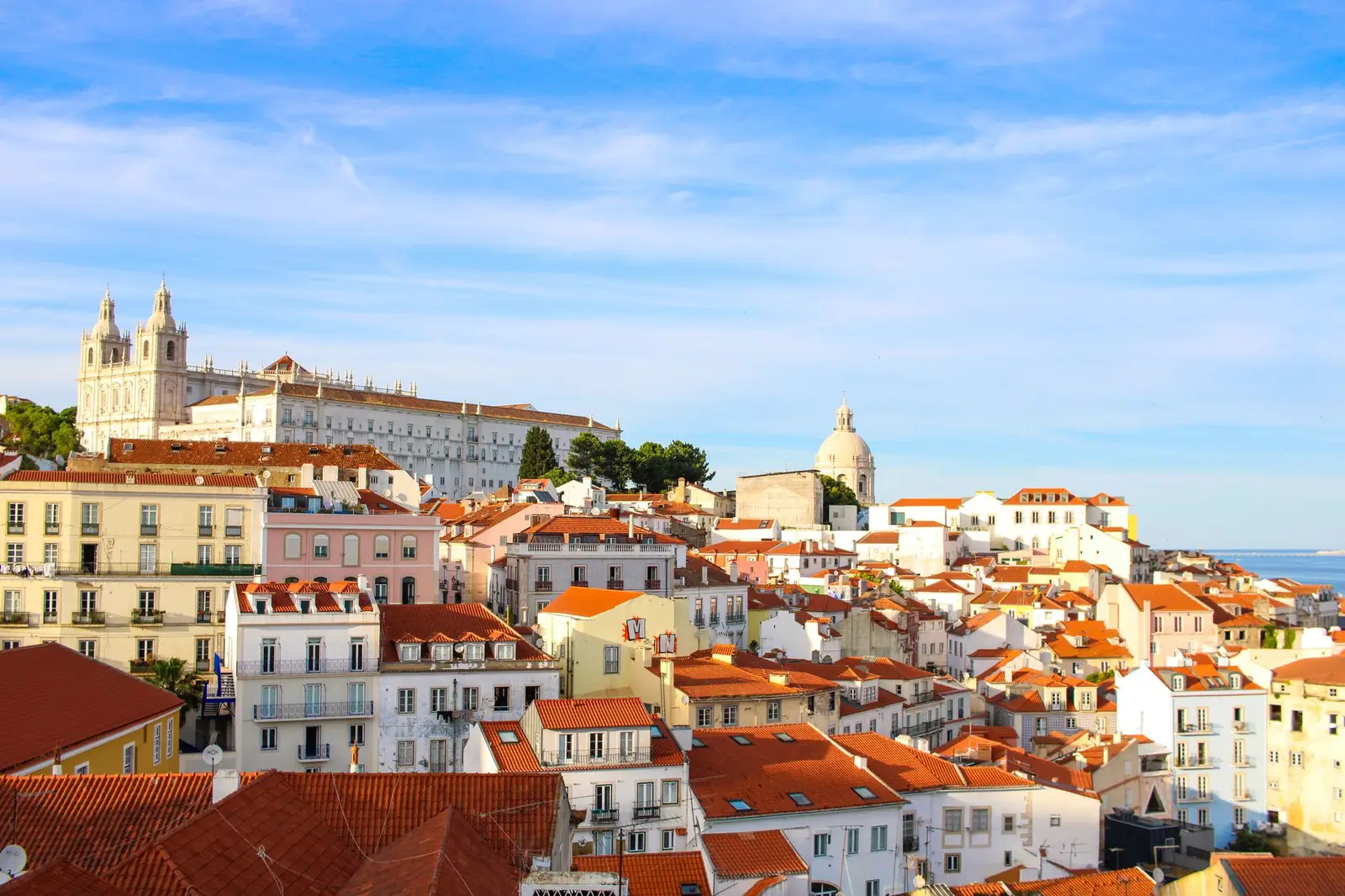
Alfama is Lisbon's oldest neighbourhood and largely survived the earthquake. Its maze-like layout dates back to Moorish times: alleys that end in stairs, stairs that end in little squares, squares where someone is grilling something. Your GPS gives up after ten minutes. That's fine, because that's exactly how Alfama is meant to be visited.
At the top of the hill stands São Jorge Castle, with walls you can walk along, peacocks that behave as if they own the place and one of the best views over the Baixa and the river. On the way up you pass Lisbon Cathedral, the 12th-century Romanesque Sé, sturdy as a fortress. It makes sense: back then, praying and defending yourself went hand in hand.
The Santa Luzia viewpoint has azulejo tile panels and bougainvillea, and Portas do Sol, right next to it, looks out over Alfama's rooftops all the way to the Tagus. In the distance, the white dome is the National Pantheon, the former Church of Santa Engrácia, whose construction dragged on for centuries and was only finished in 1966. Hence the Portuguese expression «obras de Santa Engrácia» for anything that never ends. On Tuesdays and Saturdays, the Feira da Ladra flea market sets up nearby.
At night, Alfama and neighbouring Mouraria are the home of fado, UNESCO Intangible Cultural Heritage since 2011. In fado houses you dine and listen, and there's one sacred rule: when the fadista sings, nobody talks. Not to order wine, not to comment on the octopus. Especially not to comment on the octopus.
Tram 28: the slowest rollercoaster in Europe
Lisbon's yellow trams have a design that's nearly a century old, wooden benches and a very personal relationship with tight bends. The 28 is the most famous: it runs from Martim Moniz to Campo de Ourique, through Graça, Alfama, Baixa, Chiado and Estrela. For a single ticket, it crosses half of historic Lisbon centimetres from the walls. Literally.
The problem is that the whole world had the same idea. At Martim Moniz, the mid-morning queue can take longer than the ride itself. The trick is to catch it early, before nine, or late in the afternoon, or to start at the other end, in Campo de Ourique. And hold on to your bag: a packed tram is the favourite workplace of pickpockets.
If the 28 is impossible, tram 12 runs a short loop between Praça da Figueira and the Castle area, with the same charm and fewer crowds. For anyone short on time, with small children or knees with opinions of their own, a private tour by car or tuk-tuk around the hills saves a lot of climbing and leaves energy for what matters.
Don't rush off at the end of the line. Campo de Ourique is home to Prazeres Cemetery, with family tombs that look like little palaces and a calm that's rare in the city. Along the way, the Estrela Basilica and the garden opposite deserve a stop: shady benches, a kiosk and locals reading the paper as if there were no tourists in the world.
Chiado, Bairro Alto and taking the sunset seriously
Chiado is elegant Lisbon: bookshops, theatres, old cafés and the statue of Fernando Pessoa sitting outside one of them, always available for photos and never for conversation. This is also where you'll find the bookshop considered the oldest in the world still operating, open since the 18th century. Next door, the ruins of the Carmo Convent, roofless since 1755, let the sky serve as the vault.
Just above, Bairro Alto has a split personality. By day, quiet streets, laundry hanging out and neighbours chatting from window to window. By night, hundreds of people drink in the street, glass in hand, hopping from bar to bar. If you prefer something later, head down to Cais do Sodré and Rua Nova do Carvalho, the famous pink street.
For sunset, the São Pedro de Alcântara viewpoint faces the Castle and Alfama, while Santa Catarina, with its statue of Adamastor, looks out over the river and the 25 de Abril Bridge. On the other side of the city, the Senhora do Monte viewpoint in Graça is one of the highest and gives a complete panorama. Near Chiado, Príncipe Real combines a garden, design shops and a giant cedar that works as a natural parasol.
Lisbon takes sunset so seriously that people applaud when the sun disappears. Arrive half an hour early, especially in summer, because the best spots on the wall go fast. And bring a jacket: the river wind turns up the moment the sun says goodbye, without asking permission.
Belém: monuments, river and Lisbon's sweetest queue
Belém is about 6 km west of the centre and easy to reach: tram 15 leaves from Praça da Figueira and Praça do Comércio, and the Cascais line train from Cais do Sodré takes around 10 minutes. This is where the ships of the Age of Discovery set sail, and the area still has the air of someone gazing at the horizon.
The Jerónimos Monastery, commissioned by King Manuel I in the early 16th century, is the masterpiece of the Manueline style: stone carved with ropes, shells and maritime motifs, as if the stonemasons had been to sea too. Inside lies the tomb of Vasco da Gama, and the cloister is one of those places where everyone lowers their voice without being asked.
By the river, Belém Tower is the most famous postcard in the country, listed by UNESCO together with Jerónimos. A little before it stands the Monument to the Discoveries, with navigators carved in a row and, on the ground, a huge compass rose with a map of the world. Next to it, the wavy MAAT building and, in the background, the 25 de Abril Bridge and the Cristo Rei statue complete the scene.
And then there are the pastries. The historic shop next to Jerónimos has been making pastéis de Belém since 1837, from a recipe of convent origin kept under lock and key. The takeaway queue is usually long, but the rooms inside are huge and you'll often get a table faster than you'd get served at the counter. Sprinkle on cinnamon and icing sugar. Eat it while it's warm. Repeat.
Eating and drinking: tascas, sardines and ginjinha
In Lisbon you eat best where the tablecloths are made of paper. Neighbourhood tascas serve a dish of the day at lunchtime, generous portions and house wine by the jug. Look for bacalhau (salt cod; some say there are more than 365 recipes, one for every day), polvo à lagareiro (roast octopus with olive oil), duck rice and amêijoas à Bulhão Pato, clams with garlic, coriander and lemon, perfect for mopping up with bread until the very end.
For snacks: bifana (marinated pork sandwich), prego (steak sandwich), peixinhos da horta (battered green beans) and, in summer, caracóis (snails) with an ice-cold imperial, the local draught beer. In June, during the Santos Populares and especially on the night of Saint Anthony, from the 12th to the 13th, the city smells of grilled sardines, there are street parties in every neighbourhood and pots of basil with little poems in every window.
Watch out for the couvert: bread, butter, olives or cheese appear on the table without anyone ordering them. If you eat it, you pay; if you don't want it, kindly ask for it to be taken away. To drink, try vinho verde, reds from the Alentejo and the Douro and, of course, ginjinha, the sour cherry liqueur, served with or without the cherries at the bottom of the glass. To taste a bit of everything, the Mercado da Ribeira in Cais do Sodré brings food stalls together under one roof.
The classic Lisbon breakfast is quick: a bica (espresso) and a pastry at the counter of a pastelaria, standing up, in three minutes. The pastel de nata is everywhere and, honestly, there are plenty of good ones outside Belém. Try several. In the name of science.
The secret: Torel and the other side of the river
Jardim do Torel is hidden at the top of Sant'Ana hill, above Avenida da Liberdade, and many Lisboetas have never set foot in it. It has a lawn, shady benches and a wide view over the Baixa and São Jorge Castle. You get there via steep streets or stairways, which explains why it stays so peaceful: the effort filters out the crowds.
The second secret is crossing the Tagus. At Cais do Sodré you take the cacilheiro, the ferry that links Lisbon to Cacilhas in about 10 to 15 minutes, for the price of a regular public transport ticket. It's the cheapest boat trip in the city, and the view of Lisbon drifting away, with all its hills lined up, is every bit as good as the one from the tourist cruises.
In Cacilhas there are several seafood restaurants with fish and shellfish at friendlier prices than on the other side. Then walk along Rua do Ginjal, by the river, between old warehouses, graffiti-covered walls and fishermen with their rods. At the end of the path, the Boca do Vento panoramic lift connects to the old part of Almada.
Why go? Because the best view of Lisbon is the one with all of Lisbon in it. In the late afternoon, with the city switching on its lights and the 25 de Abril Bridge beside you, you finally see the shape of the capital. And the boat ride back after dark is the kind of moment that never makes it into the brochures.
A perfect day in Lisbon
08:30
Tram 28 before the queues
Catch the 28 at Martim Moniz while the city is still waking up. Sit by the window and get off around Graça or Portas do Sol.
09:30
São Jorge Castle
Walls, peacocks and the first great view of the day. Arriving early means photos without other people's heads.
11:00
Wander down Alfama without a map
Santa Luzia, Portas do Sol, alleys and stairways down to the Cathedral. Getting lost is compulsory; the river is always downhill.
12:30
Baixa and a tasca lunch
Praça do Comércio, the Rua Augusta Arch and Rossio. Have the dish of the day at a tasca on a side street, far from the menus with photos.
14:30
Off to Belém
Tram 15 or the train from Cais do Sodré. Visit the Jerónimos Monastery and save time for the cloister.
16:30
Pastries and a riverside walk
Pastéis de Belém still warm, then walk past the Monument to the Discoveries to Belém Tower.
18:30
Chiado and sunset
Head back to the centre, stroll through Chiado and climb to the São Pedro de Alcântara or Santa Catarina viewpoint for the daily show.
20:30
Dinner with fado
Alfama or Mouraria, a fado house, red wine and silence when the voice begins. Or petiscos, if fado can wait until tomorrow.
22:30
Bairro Alto or Cais do Sodré
A drink in the street in Bairro Alto or a ginjinha to end the day. Your legs will complain tomorrow, but not tonight.
What it costs
Lisbon is no longer the bargain it was fifteen years ago, but it's still one of the capitals where a good lunch doesn't require a loan. What really adds up is the pastries, because of the quantity.
Budget
70–110 €
per person, per day
Hostel or simple room, tasca lunches, a transport pass and viewpoints, which are free and the best in town.
Comfortable
150–250 €
per person, per day
Central hotel, entry to the main monuments, restaurant dinners and a fado night.
No expense spared
400–800 €
per person, per day
Boutique hotel with a river view, private tours, seafood without counting the clams and fine cellar wines.
Single metro ride
per ride · With a rechargeable card
1,80 € – 2,20 €
24-hour pass (metro, bus and tram)
per person
7 € – 11 €
Tram ticket bought on board
per ride · Dearer than with the card
3 € – 4 €
Pastel de nata
each
1,20 € – 2 €
Bica (espresso)
per coffee
0,80 € – 1,50 €
Tasca lunch (dish of the day)
per meal
10 € – 18 €
Dinner at a mid-range restaurant
per person · With house wine
25 € – 45 €
Dinner with fado
per person
45 € – 90 €
Jerónimos Monastery entrance
per person
12 € – 18 €
São Jorge Castle entrance
per person
14 € – 18 €
Mid-range hotel in the centre
per night, double room · Plus the municipal tourist tax
110 € – 220 €
Taxi or ride-hailing from the airport to the centre
per ride
12 € – 25 €
Approximate reference values for 2026. Always check before you go.
Tourist mistakes to avoid
- ✕Waiting an hour for tram 28 at Martim Moniz at midday. Go early, late in the afternoon, or start at the other end of the line.
- ✕Having dinner on Rua Augusta at a restaurant with a photo menu and a waiter pulling you in by the arm. Two streets away you'll eat better and for less.
- ✕Renting a car to get around the historic centre. Narrow streets, no-entry signs and parking that's almost a legend. Use your legs, the metro and the trams.
- ✕Riding a packed tram with your wallet in your back pocket. Pickpockets appreciate the heritage too.
- ✕Eating the whole couvert and then being surprised by the bill. If you don't want it, ask for it to be taken away right at the start.
- ✕Planning Belém for a Monday, or trying to see Lisbon, Sintra and Cascais on the same day. Sintra deserves a full day, not a sprint.
«In Lisbon there are no uphill streets. There are streets that haven't come down yet.»
More photos of Lisbon
Already packing?
Tours and transfers in Lisboa

Frequently asked questions
How many days do you need to visit Lisbon?
Two to three days let you see Alfama, the Baixa, Chiado, Belém and the main viewpoints without rushing. With four days you can add a visit to Sintra or the Cascais coast. In a single day you'll see the essentials, but at marathon pace.
Is tram 28 worth it?
Yes, it's a fun way to cross the historic neighbourhoods, but the queues can be long. Catch it early in the morning or late in the afternoon and watch out for pickpockets. If it's too crowded, tram 12 is a good alternative.
Where can you eat the best pastéis de nata in Lisbon?
The pastéis de Belém, from the historic shop next to the Jerónimos Monastery, are the most famous and have had their own recipe since 1837. Even so, there are many neighbourhood pastry shops with excellent pastéis de nata. The best plan is to try them in several places and draw your own conclusions.
How do you get from Lisbon airport to the centre?
The metro, on the red line with one change, takes about 25 to 35 minutes to the Baixa. By taxi, ride-hailing or transfer it's 15 to 25 minutes without traffic. With big suitcases or late arrivals, a transfer is usually the most practical option.
What's the best area to stay in Lisbon?
Baixa and Chiado are the most practical, with everything within walking distance and good transport links. Alfama has more charm but means more climbing. Príncipe Real and Cais do Sodré suit those looking for restaurants and nightlife.
Prices, opening hours and rules are approximate reference values and may change: always check before you go. Photos: Pexels.