How long
A full day. The palace needs two to three hours, and the gardens and Trianons as much again.
Best time
Spring to early autumn, when the fountains run during the musical shows. The palace is closed on Mondays.
Getting there (from Paris)
About 20 km from Paris. By RER or suburban train, 30 to 45 minutes, plus about 10 minutes' walk to the palace.
Ideal for
Lovers of history, palaces and gardens, and anyone who wants to understand how Europe's most powerful court lived.
Don't forget
A timed ticket bought online and comfortable shoes: the park is huge.
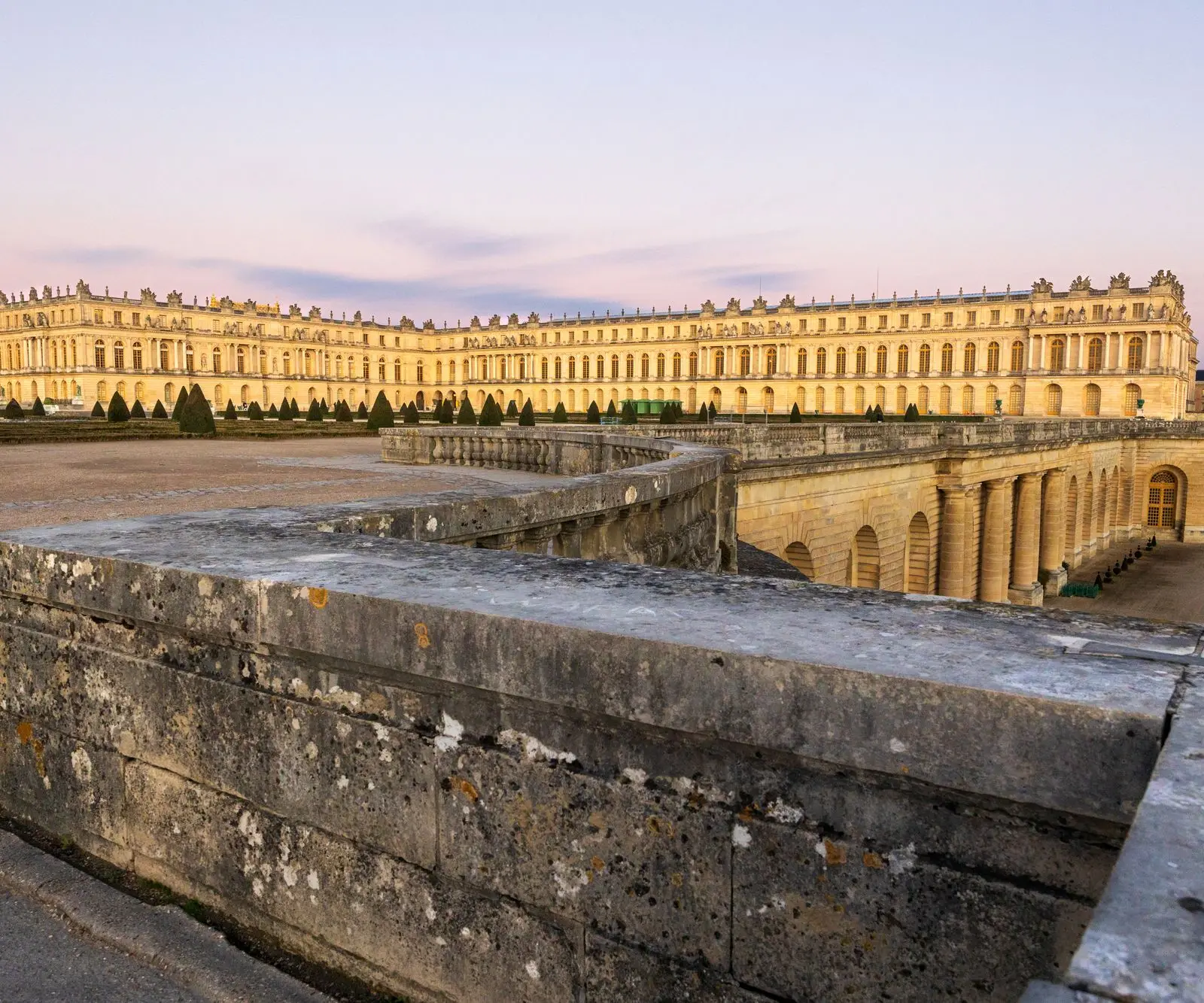
Versailles began as a hunting lodge and became, by the will of Louis XIV, the most famous palace in the world. The Sun King moved the whole court here in 1682, and for more than a hundred years France was governed from here, among gilded halls, endless parties and a protocol so rigid that even the king's waking up was a public ceremony. Today it's a UNESCO World Heritage Site that welcomes millions of visitors and still impresses. The secret is knowing where to start and when to arrive.
The palace: the Sun King's court
You enter through the gilded gates into the Marble Courtyard, the heart of the palace. The visit takes in the King's and Queen's State Apartments, halls dedicated to gods and planets, with painted ceilings, coloured marble and gilding everywhere.
The Royal Chapel, white and gold, and the Royal Opera, all in wood painted to look like marble, are two of the most beautiful rooms. In the private apartments you see how the royal family lived, always watched by courtiers.
The palace gets very busy from late morning. Arrive at opening with a timed ticket and head straight to the main wing, leaving the less visited apartments for later.
The Hall of Mirrors
The Hall of Mirrors is Versailles's most famous room: a gallery more than seventy metres long, with seventeen large windows facing the gardens and, opposite, seventeen arches holding hundreds of mirrors, at a time when mirrors were an enormous luxury. Crystal chandeliers and a painted ceiling celebrate Louis XIV's victories.
It was here, in 1919, that the Treaty of Versailles was signed, ending the First World War. And here balls and receptions were held that were, above all, displays of power.
To see it with fewer people, go at opening or late in the afternoon. At midday the gallery is so crowded that the mirrors mostly reflect phones.
Le Nôtre's gardens and the fountains
The gardens, designed by André Le Nôtre, are the model of the French formal garden: geometric perspectives, patterned beds, avenues, statues and dozens of fountains. The Grand Canal, over a kilometre and a half long, crosses the park and can be explored by rowing boat.
On show days, especially weekends from spring to autumn, the fountains play to baroque music, as in the king's time. The Apollo Fountain, with the god rising from the water in a horse-drawn chariot, is the most spectacular.
The park is enormous. Rent a bike or take the little train linking the palace to the Trianons. In summer there are night shows with illuminated fountains and fireworks.
The Trianons and the Queen's Hamlet
Far from the palace protocol, the royal family had more intimate retreats. The Grand Trianon, in pink marble, was built for Louis XIV to rest from the court. The Petit Trianon was given by Louis XVI to Marie Antoinette.
Nearby the queen had the Hameau de la Reine built, a rustic hamlet of thatched cottages with a mill, a lake and a farm, where she played at being a peasant away from the court's eyes. It's one of the most charming and strangest corners of Versailles.
The Trianons get far fewer visitors than the palace, and the gardens around them are more romantic and informal. Many visitors feel the best of the visit is here.
Practical tips: tickets, transport and food
Buy your ticket online with a timed entry to the palace. The «Passport» ticket includes the palace, the Trianons and, on show days, the gardens with the musical fountains. Remember the palace is closed on Mondays.
From Paris, RER and suburban trains reach Versailles in 30 to 45 minutes. To avoid changes and walking, a transfer or private tour drops you at the door and lets you combine Versailles with a Paris tour on the same day.
Inside the estate there are restaurants and cafés, some elegant, some simple, and picnics are allowed in certain areas of the park. In the town of Versailles, the Notre-Dame district and its market are a good alternative for lunch.
A perfect day at Versailles
08:30
Early arrival
Train from Paris and coffee in town before opening.
09:00
Palace
The Marble Courtyard, the State Apartments and the Royal Chapel.
11:30
Hall of Mirrors
The world's most famous gallery, while it's still quiet.
13:00
Lunch
A restaurant on the estate or a picnic in the park.
14:30
Gardens and fountains
The musical fountains, the Apollo Fountain and the Grand Canal.
16:30
Trianons and Hamlet
The Grand Trianon, the Petit Trianon and the queen's hamlet.
18:00
Back to Paris
Train or transfer, with time for dinner in the city.
What it costs
Versailles is reasonably priced for what it offers. The all-inclusive ticket pays off if you want to see the Trianons too.
Budget
45–80 €
per person, per day
Train, palace ticket, gardens on free days and a picnic in the park.
Comfortable
100–180 €
per person, per day
Passport ticket, a bike in the park, lunch on the estate and the musical fountains.
No expense spared
300–650 €
per person, per day
Private guided tour from Paris, a visit with fewer queues and dinner at a chef's restaurant.
Passport ticket (palace, Trianons and gardens)
per person · More on musical fountain days
21 € – 35 €
Palace only
per person
10 € – 15 €
Train from Paris
per person, one way
4 € – 8 €
Bike rental in the park
per hour
15 € – 25 €
Lunch on the estate
per person
20 € – 40 €
Hotel in Versailles
per night, double room
90 € – 180 €
Rowing boat on the Grand Canal
per half hour
5 € – 10 €
Private tour from Paris
per person · Depends on group size
60 € – 150 €
Approximate reference values for 2026. Always check before you go.
Tourist mistakes to avoid
- ✕Going on a Monday. The palace is closed.
- ✕Arriving without a timed ticket in high season.
- ✕Visiting the palace at noon, when it's busiest.
- ✕Seeing only the palace and skipping the gardens and Trianons.
- ✕Underestimating the size of the park. Use a bike or the little train.
- ✕Forgetting to check the musical fountain days.
«At Versailles, even the mirrors have more history than many countries.»
More photos of Versailles
Frequently asked questions
How do I get from Paris to Versailles?
By RER or suburban train, 30 to 45 minutes, plus about 10 minutes' walk to the palace. A transfer or private tour drops you at the door.
How long do I need to visit Versailles?
A full day for the palace, gardens and Trianons. The palace alone takes two to three hours.
When do the Versailles fountains run?
On musical fountain show days, mainly weekends from spring to autumn and some weekdays in summer. Check the official calendar.
On which day is the Palace of Versailles closed?
Monday. The gardens may be open, but the palace isn't.
What is the Hameau de la Reine?
The rustic hamlet Marie Antoinette had built near the Petit Trianon, with thatched cottages, a mill, a lake and a farm, where the queen escaped the court.
Prices, opening hours and rules are approximate reference values and may change: always check before you go. Photos: Pexels.