How long
Two days for the city and one in the vineyards. With more time, add Arcachon and the Dune du Pilat.
Best time
Spring and autumn. In September and October it's harvest time, and the vineyards turn golden.
Getting there (from Lisbon)
There are direct flights from Lisbon and Porto to Bordeaux of under two hours. From Paris, the TGV takes just over two hours.
Ideal for
Wine lovers, fans of elegant architecture, walkable cities and good food.
Don't forget
Book château visits in advance. Many only welcome visitors by appointment.
Bordeaux gave its name to one of the world's most famous wines, and for a long time that's all it was to many travellers: a label. But the city itself is a surprise. It has an almost intact eighteenth-century centre of pale stone and iron balconies, a UNESCO World Heritage Site, renovated quays along the Garonne and a water mirror where people walk on the reflection of palaces. Around it lies the largest fine-wine region in the world, with villages and châteaux that look designed for postcards. Cheers.
Place de la Bourse and the Miroir d'Eau
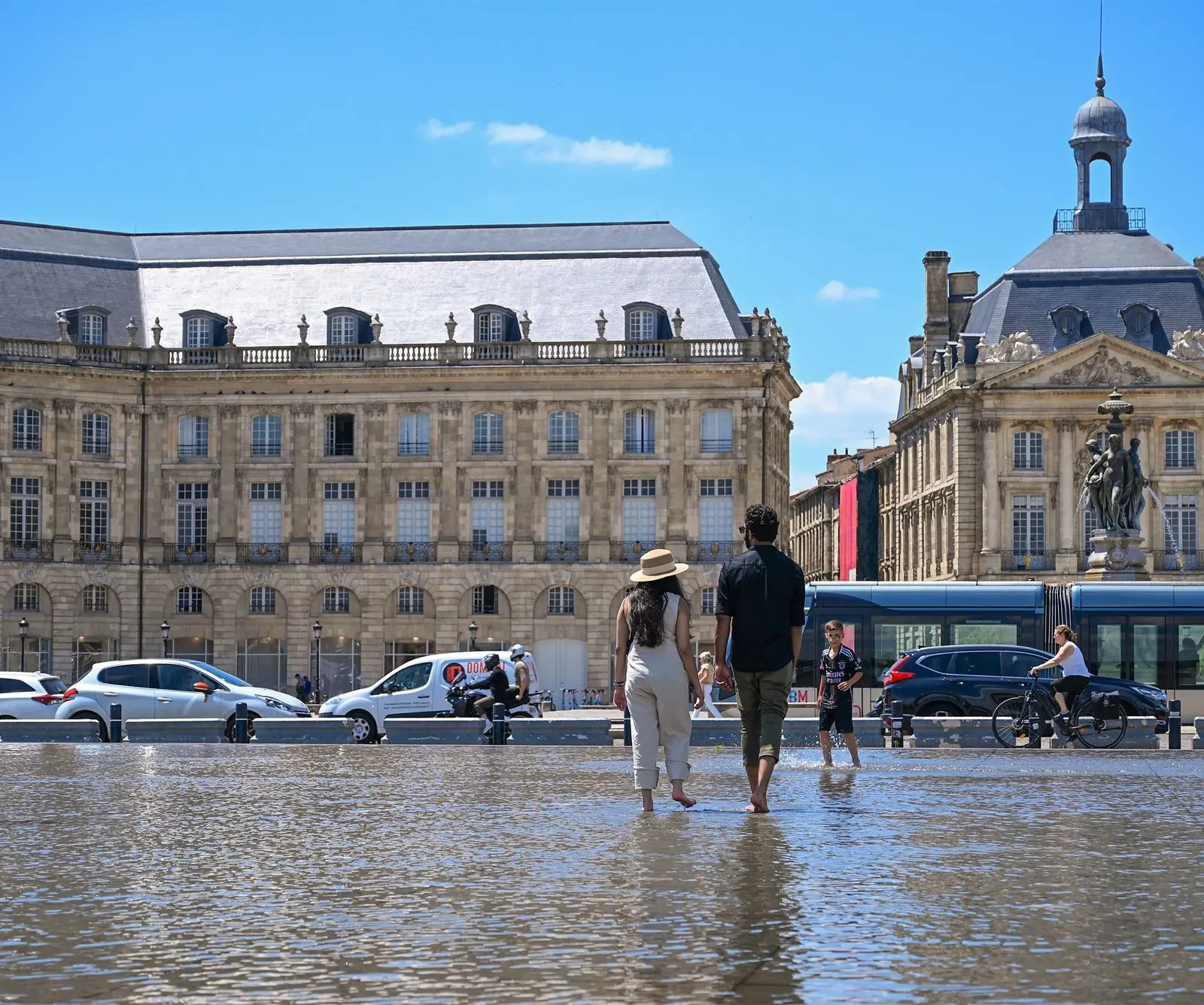
The eighteenth-century Place de la Bourse opens onto the Garonne with an elegant façade of classical palaces. In front is the Miroir d'Eau, the world's largest reflecting pool: a thin sheet of water on granite that mirrors the buildings and, every so often, turns into mist.
It's the most photographed spot in Bordeaux, and the most fun too. Children and adults run barefoot across the water, and at sunset and at night the reflection of the illuminated palaces is spectacular.
The quays along the Garonne have been turned into a promenade several kilometres long, with gardens, cycle paths and terraces. Walking to the Pont de Pierre, built on Napoleon's orders, is one of the city's best strolls.
The centre: the eighteenth-century city
Bordeaux is known as the «Port of the Moon» because of the crescent-shaped bend the river makes by the centre, and its historic ensemble is a UNESCO World Heritage Site. Pale stone streets, wide squares and uniform façades give it a rare elegance.
The Gothic Saint-André Cathedral stands beside the Pey-Berland Tower, from which you see the whole city after a few hundred steps. The Grand Théâtre, with monumental columns, and the Grosse Cloche, an old medieval gate with an enormous bell, are other must-sees.
Rue Sainte-Catherine is one of the longest pedestrian shopping streets in Europe. Around it, the Saint-Pierre and Saint-Michel districts have squares with terraces, markets and lively bars.
The Cité du Vin and the Chartrons
The Cité du Vin, opened in 2016, is a museum dedicated to wine worldwide, in a curved, shining building that recalls a decanter or wine swirling in a glass. The visit is interactive, with aromas, stories and wine cultures from several continents.
At the top, the ticket includes a glass of wine on the viewpoint, overlooking the river and the city. It's a very pleasant way to end the visit and start the conversation about what to taste next.
Between the centre and the Cité du Vin lies the Chartrons, the old wine merchants' quarter, with warehouses converted into antique shops, cafés and wine shops. On Sunday mornings there's a market by the river.
The vineyards: Saint-Émilion, the Médoc and more
Around Bordeaux there are dozens of wine appellations and thousands of châteaux, as wine estates are called here, many with buildings that look like palaces. The two great banks are the left, with the Médoc and its Cabernet Sauvignon reds, and the right, with Saint-Émilion and Pomerol, dominated by Merlot.
Saint-Émilion, about 40 minutes away, is a medieval village and UNESCO World Heritage Site, with steep stone streets, cellars dug into the rock and a monolithic church carved inside a hill. It's probably the most beautiful trip from Bordeaux.
In the Médoc, the château road passes estates with legendary names. To visit and taste calmly without having to drive afterwards, a private tour with a driver is by far the best option. And spare a thought for Sauternes, the region's sweet wine.
Eating in Bordeaux: canelés, oysters and entrecôte
Bordeaux's sweet is the canelé, a small fluted cake caramelised outside and soft inside, with rum and vanilla. Try them warm at a traditional pastry shop and understand why locals eat them at any hour.
Oysters from the Arcachon Bay, an hour away, arrive fresh at the markets and restaurants, and the Marché des Capucins is the ideal place to eat them at the counter with a glass of dry white. Entrecôte à la bordelaise, with a red wine and shallot sauce, is the classic meat dish.
If you have time, Arcachon and the Dune du Pilat, Europe's tallest sand dune at over a hundred metres high, are about an hour away. Climbing the dune at sunset, with the ocean on one side and the forest on the other, is unforgettable.
A perfect day in Bordeaux
09:00
Place de la Bourse
The Miroir d'Eau in the morning, before the crowds.
10:30
Historic centre
Saint-André, the Pey-Berland Tower and the Grosse Cloche.
12:30
Lunch at the Marché des Capucins
Oysters and white wine at the counter.
14:00
Chartrons
Antique shops, cafés and wine shops in the old merchants' quarter.
16:30
Cité du Vin
The interactive visit and a glass of wine on the viewpoint.
18:30
Garonne quays
A walk to the Pont de Pierre at sunset.
20:30
Dinner
Entrecôte à la bordelaise with a left-bank red.
What it costs
Bordeaux is more affordable than Paris. Wine, curiously, can be cheap or very expensive: it depends on the label and your mood.
Budget
80–130 €
per person, per day
Hostel, the Miroir d'Eau, the centre on foot, the market and at least one canelé a day.
Comfortable
170–300 €
per person, per day
Central hotel, the Cité du Vin, a day in Saint-Émilion and dinners with wine.
No expense spared
450–900 €
per person, per day
Sleep in a château among the vines, a starred restaurant and a private tour of the Médoc and Saint-Émilion.
Hostel bed
per night
30 € – 50 €
Mid-range hotel
per night, double room · More expensive during big wine fairs
100 € – 180 €
Luxury hotel or château
per night, double room
220 € – 450 €
Cité du Vin
per person · Includes a glass on the viewpoint
20 € – 30 €
Private vineyard tour with tastings
per person
80 € – 160 €
Canelé
each
3 € – 5 €
Menu of the day at lunch
per meal
18 € – 28 €
Dinner with wine
per person
35 € – 65 €
Tasting at a château
per person · The most famous cost more
15 € – 50 €
Approximate reference values for 2026. Always check before you go.
Tourist mistakes to avoid
- ✕Driving through the vineyards after several tastings. Choose a driver.
- ✕Turning up at a château without an appointment and expecting a welcome.
- ✕Staying in the city and never seeing a single vineyard.
- ✕Eating cold supermarket canelés and thinking it's the same.
- ✕Ignoring the right bank. Saint-Émilion is as important as the Médoc.
- ✕Climbing the Dune du Pilat at noon in August without water.
«In Bordeaux, nobody asks if there's wine. They ask which bank.»
More photos of Bordeaux
Frequently asked questions
How do I get from Lisbon to Bordeaux?
By plane, there are direct flights from Lisbon and Porto of under two hours. From Paris, the TGV takes just over two hours.
What is the Miroir d'Eau?
A huge reflecting pool in front of Place de la Bourse, a thin layer of water on granite that mirrors the palaces and sometimes turns to mist. It's free.
How do I visit the Bordeaux vineyards?
On an organised or private tour from the city to Saint-Émilion, the Médoc or other areas. Many châteaux only receive visitors by appointment.
What is a canelé?
A small Bordeaux cake, caramelised outside and soft inside, with rum and vanilla. It's eaten at any time of day.
Is the Dune du Pilat far from Bordeaux?
About an hour by car, near Arcachon. It's Europe's tallest sand dune and pairs well with Arcachon oysters.
Prices, opening hours and rules are approximate reference values and may change: always check before you go. Photos: Pexels.