How long
Two days for Nice and one or two for the Riviera. It's the best base for exploring the Côte d'Azur.
Best time
May to October for the beach. Winter is mild, and February brings the Carnival and the Battle of Flowers.
Getting there (from Lisbon)
There are direct flights from Lisbon to Nice of about two and a half hours. The airport is minutes from the centre, by the sea.
Ideal for
Couples, families, lovers of art, markets, beaches and cities with beautiful light.
Don't forget
Water shoes or flip-flops: Nice's beaches are pebbles, not sand.
Nice is the capital of the Côte d'Azur and has the light that made painters like Matisse and Chagall move here and never leave. The city stretches along a blue bay, with a seven-kilometre promenade, an old town of warm colours and narrow streets, flower markets and a hill overlooking it all. It has a city beach, simple and delicious Mediterranean food, and Monaco, Èze and Cannes less than an hour away. No wonder European royalty spent its winters here.
The Promenade des Anglais and the Bay of Angels
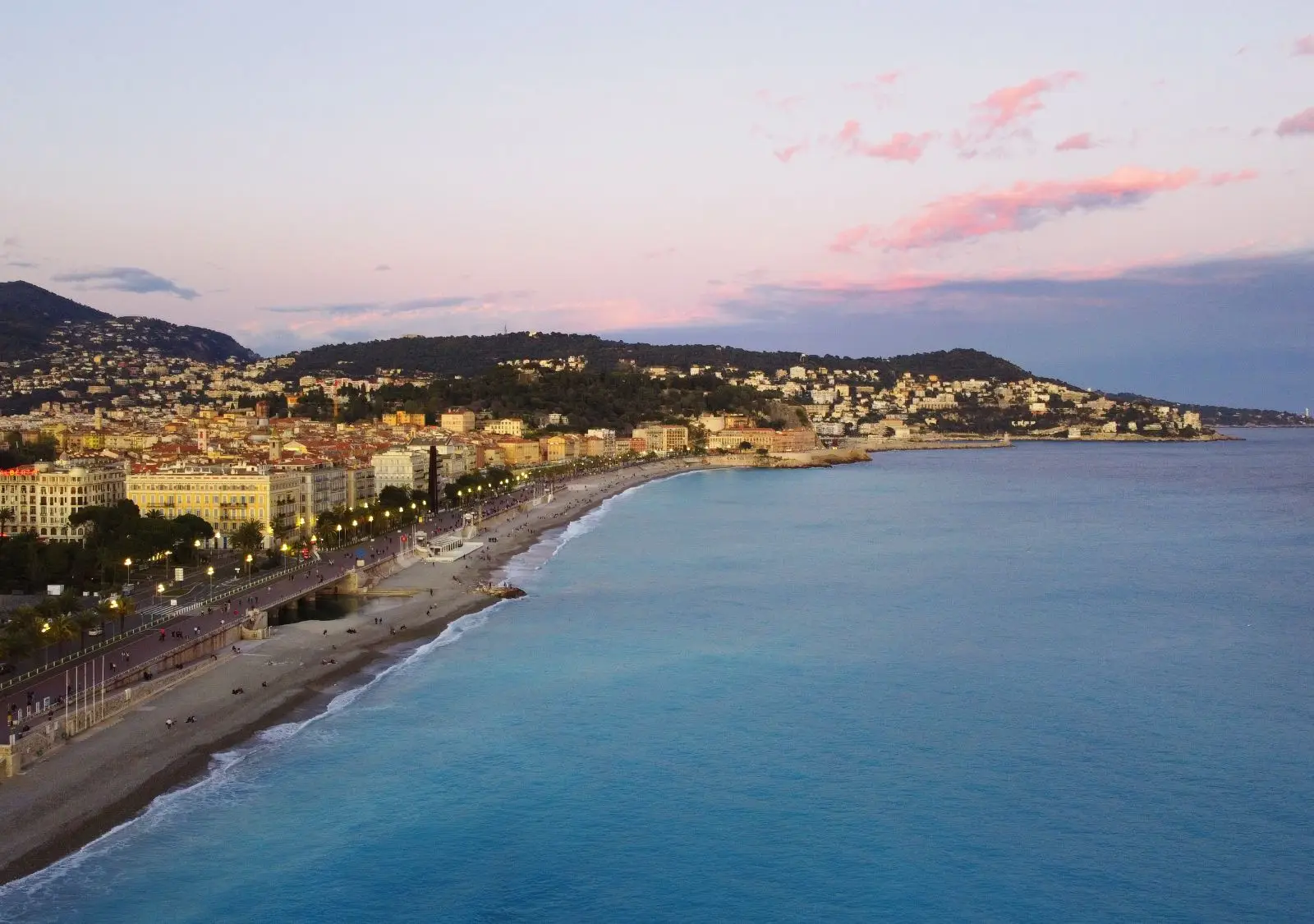
The Promenade des Anglais follows the Bay of Angels for about seven kilometres, with palm trees, the famous blue chairs and Belle Époque hotels such as the Negresco with its pink dome. The name comes from the English aristocrats who wintered here in the nineteenth century.
Walking, running, cycling or simply sitting in a blue chair looking at the sea are the Promenade's official activities. In the late afternoon, the light on the water is among the most beautiful in the Mediterranean.
Nice's beaches are pebbles, which surprises those expecting sand. There are free public beaches and private beaches with sunbeds and restaurants. The water is an intense blue and, in summer, very inviting.
Vieux-Nice and the Cours Saleya
The old town, Vieux-Nice, is a maze of narrow streets with ochre, yellow and pink façades, laundry drying at windows, baroque churches and little squares. It feels very Italian, and not by chance: Nice only became French in 1860.
The Cours Saleya is the long market square. In the morning there are stalls of flowers, fruit, vegetables, spices and Provençal produce; on Mondays, antiques. In the evening the square fills with terraces and restaurants.
Try socca, a thin chickpea pancake baked in a wood oven, pissaladière with onions and anchovies, and pan bagnat, the salade niçoise sandwich. Simple, cheap and addictive street food.
Castle Hill: the best view of Nice
Between Vieux-Nice and the port rises the Colline du Château, a hill once home to a castle destroyed in the eighteenth century. Today it's a park with paths, shade, an artificial waterfall and the city's best viewpoints.
You climb on foot by stairs, or by a free lift from near the Promenade. From the top you see the whole Bay of Angels on one side and the Lympia port with its colourful boats on the other.
In the late afternoon it's a perfect place to rest, and the photos of the bay from here are Nice's most famous.
Matisse, Chagall and the city of the arts
Henri Matisse lived in Nice for decades, and the Matisse Museum, in an Italian villa in the Cimiez district, shows works from every period of his life. Next to it are Roman ruins and a monastery with gardens overlooking the city.
The Marc Chagall National Museum holds his series of large paintings inspired by the Bible, in a building designed for them, with stained glass and a Mediterranean garden. It's one of the most moving museums in the region.
There's also the modern and contemporary art museum and the Promenade du Paillon, a linear park with gardens and fountains in the city centre. Since 2021 Nice has been a UNESCO World Heritage Site as the winter resort town of the Riviera.
The Riviera: Monaco, Èze, Villefranche and Cannes
East of Nice, the coast road passes Villefranche-sur-Mer, a deep bay with colourful houses, and reaches Monaco in under half an hour, with the Monte-Carlo Casino, the Prince's Palace and a harbour full of yachts.
Èze is a medieval village perched on a rock above the sea, with stone streets, artists' shops and an exotic garden at the top with one of the most impressive views on the Côte d'Azur. Saint-Paul-de-Vence, inland, is another fortified village that drew artists.
To the west are Antibes and Cannes, with its film festival and the Croisette. A private tour lets you combine Èze, Monaco and Villefranche in a single day, with stops at the Corniche viewpoints.
A perfect day in Nice
09:00
Cours Saleya
The flower market and hot socca at the counter.
10:30
Vieux-Nice
Narrow streets, baroque churches and ochre façades.
12:30
Castle Hill
Up for the view of the Bay of Angels and the port.
14:30
Lunch
Salade niçoise or pan bagnat on a terrace.
16:30
Matisse Museum
Matisse's works and the gardens of Cimiez.
18:30
Promenade des Anglais
Late afternoon in a blue chair, swim optional.
20:30
Dinner in Vieux-Nice
Niçoise cooking and a Provence rosé.
What it costs
Nice is expensive to sleep in during summer, but street food is good and cheap, and the best of the city, the sea and the light, is free.
Budget
90–150 €
per person, per day
Hostel, street food, public beaches, Castle Hill and buses along the coast.
Comfortable
200–350 €
per person, per day
Central hotel, museums, a private beach, dinners with wine and a day in Monaco.
No expense spared
500–1100 €
per person, per day
Luxury hotel on the Promenade, starred restaurants and a private Riviera tour to Monaco.
Hostel bed
per night · More expensive in July and August
35 € – 60 €
Mid-range hotel
per night, double room
120 € – 220 €
Hotel on the Promenade or luxury
per night, double room
250 € – 600 €
Socca or pissaladière
per portion
3 € – 6 €
Matisse or Chagall Museum
per person
12 € – 15 €
Sunbed at a private beach
per day
20 € – 35 €
Menu of the day at lunch
per meal
15 € – 25 €
Dinner with wine
per person
35 € – 60 €
Bus to Monaco or Èze
per person, one way
2 € – 8 €
Approximate reference values for 2026. Always check before you go.
Tourist mistakes to avoid
- ✕Going to the beach with nothing between you and the pebbles.
- ✕Eating at the most touristy Cours Saleya terraces without comparing prices.
- ✕Staying in Nice and never seeing Èze, Villefranche or Monaco.
- ✕Driving to Monaco at rush hour in summer. Coastal buses and trains are quicker.
- ✕Visiting Monaco on Grand Prix weekend without realising. Everything changes and prices triple.
- ✕Leaving without trying socca, even just once.
«In Nice the light does half the work. The rosé does the rest.»
More photos of Nice
Frequently asked questions
How do I get from Lisbon to Nice?
By plane, there are direct flights of about two and a half hours. The airport is very close to the centre, by the sea, a few minutes by tram or transfer.
Are Nice's beaches sandy?
No, they're pebbles. Bring water shoes and a thick mat, or choose a private beach with sunbeds.
How long do I need in Nice?
Two days for the city and one or two for the Riviera: Monaco, Èze, Villefranche, Antibes or Cannes.
What should I eat in Nice?
Socca, pissaladière, pan bagnat, salade niçoise and petits farcis, stuffed vegetables. To drink, a Provence rosé.
Can I go from Nice to Monaco in a day?
Yes. Monaco is about 20 km away, by train, bus or car. Many visitors combine Monaco, Èze and Villefranche on the same day.
Prices, opening hours and rules are approximate reference values and may change: always check before you go. Photos: Pexels.