How long
Three to four days for the essentials. Paris never runs out, so don't try to do it all.
Best time
Spring and early autumn. Summer is crowded; December brings Christmas lights and cold.
Getting there (from Lisbon)
There are many direct flights from Lisbon and Porto of about two and a half hours. From Charles de Gaulle airport to the centre, allow 45 minutes to an hour.
Ideal for
First-timers, couples, lovers of art, history and good food, and anyone who has dreamed of Paris since childhood.
Don't forget
Book the Louvre, the Eiffel Tower and the restaurants you really want in advance. In Paris, spontaneity has its limits.
Paris needs no introduction, but it deserves a strategy. It's the city of the Eiffel Tower, the Louvre, Notre-Dame and the Champs-Élysées, but also of terraces facing the street, neighbourhood bakeries, bookstalls along the Seine and unplanned afternoons in the gardens. A first visit always has a bit of a checklist. The second is for learning to sit at a café and watch Paris go by, which is the Parisians' own favourite activity.
The Eiffel Tower and the Champs-Élysées
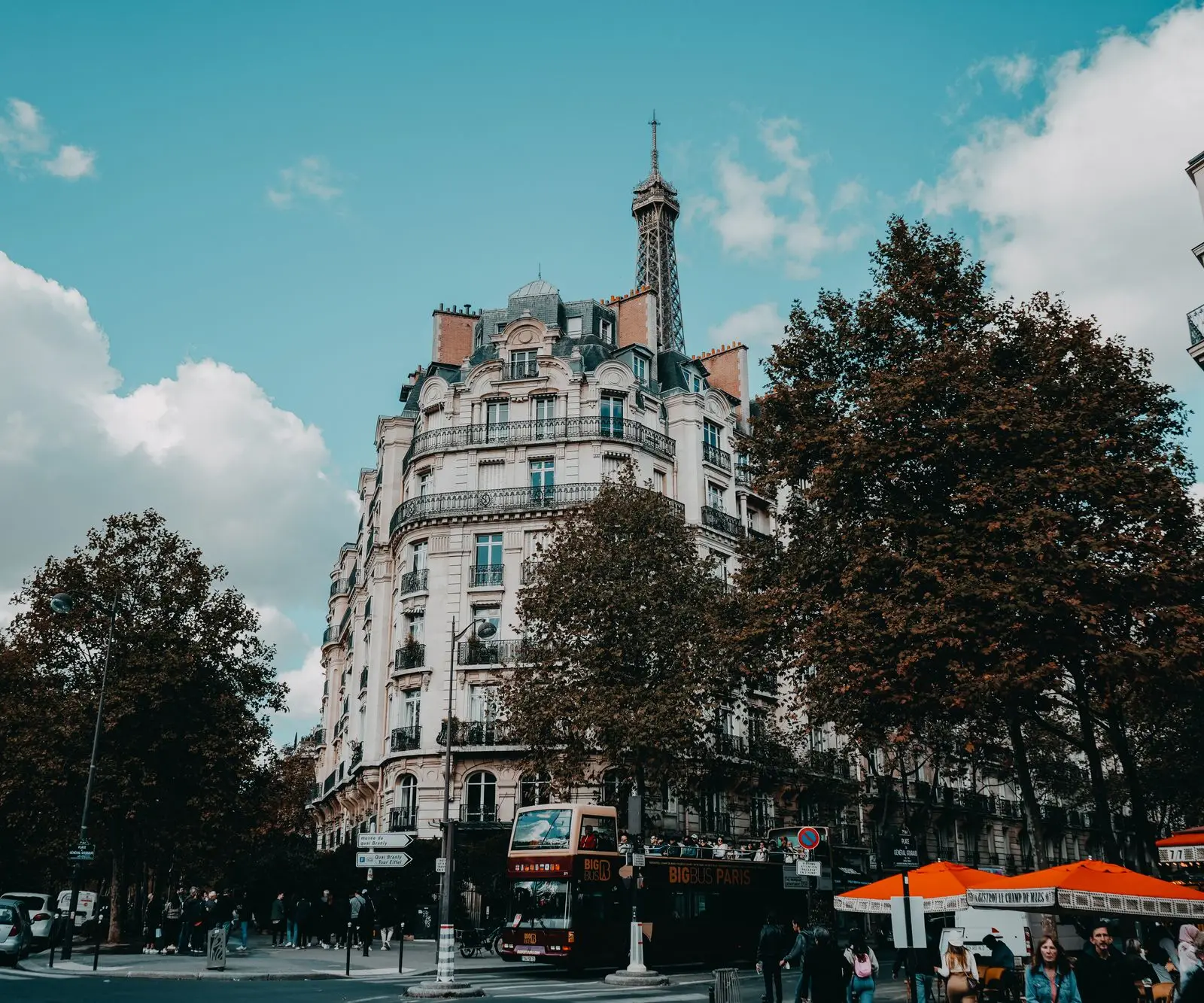
Built for the 1889 World's Fair and heavily criticised at the time, the Eiffel Tower became the symbol of Paris and of France itself. You go up by lift or, as far as the second floor, by the stairs. The view from the top is incredible, but many people think the best view of the Tower is from outside.
The best places to see it are the Trocadéro across the Seine, the lawns of the Champ de Mars and the bridges around. At night, for a few minutes at the start of each hour, the Tower sparkles with thousands of lights, and someone always applauds.
From there, the Champs-Élysées climb to the Arc de Triomphe, whose terrace shows the star of avenues laid out in the nineteenth century. The avenue is more about shops than charm, but the walk is part of a first visit.
The museums: the Louvre, Orsay and friends
The Louvre is the world's largest museum by area and holds the Mona Lisa, the Venus de Milo and the Winged Victory of Samothrace, among thousands of other works. Seeing everything is impossible. Pick two or three wings, book a timed ticket and don't be frustrated by the crowd in front of the Mona Lisa: she's smaller than she looks in photos.
The Musée d'Orsay, housed in a former railway station, has the world's largest collection of Impressionist painting: Monet, Renoir, Degas, Van Gogh. The giant clock on the façade, seen from inside, is one of the most beautiful photos in the city.
The Orangerie, with Monet's water lilies in oval rooms, the Rodin Museum with its sculpture garden, and the Centre Pompidou for modern art round off the list. If you're visiting many museums, the museum pass can pay off.
The Seine, Notre-Dame and the islands
Paris's historic heart is the Île de la Cité, an island in the Seine where Notre-Dame stands. The Gothic cathedral, badly damaged by fire in 2019, reopened at the end of 2024 after an impressive restoration and is once again one of the city's most visited sites.
Very close by, the Sainte-Chapelle has walls made almost entirely of thirteenth-century stained glass. On a sunny day, stepping inside is like entering a jewel. Next door, the Île Saint-Louis is quiet and elegant, famous for its ice cream.
A boat trip on the Seine is the easiest way to see all of Paris at once, especially in the evening. On foot, the riverbanks with the bouquinistes and their green boxes are the most Parisian walk of all.
Montmartre: the artists' hill
In the north of the city, Montmartre is a hill of steep streets and stairways crowned by the white Sacré-Cœur basilica. From the steps in front, the view over the rooftops of Paris is one of the best, and at sunset they fill with people and guitars.
Behind the basilica is the Place du Tertre, with painters working outdoors, and streets that still keep the village feel that drew Picasso, Renoir and so many others. There's a small vineyard, old cafés and cabarets.
At the foot of the hill is the Moulin Rouge, with its red windmill and cancan shows. Montmartre is very touristy around the basilica, but two streets away you'll find a calmer Paris.
Neighbourhoods and food: the Marais, the Latin Quarter and more
The Marais is one of the most beautiful and lively neighbourhoods, with old mansions, the Place des Vosges, shops, galleries and bars. It's also the old Jewish quarter, home to some of the city's best falafel. The Latin Quarter, by the Sorbonne, has narrow streets, bookshops and the Luxembourg Gardens.
Food is part of the visit. Bakery croissants and baguettes, a croque-monsieur in a bistro, steak frites with red wine, cheeses, macarons and a neighbourhood bistro meal with the menu of the day chalked on the board. In Paris you eat well at every price, as long as you avoid the traps next to the monuments.
At night, Saint-Germain, Canal Saint-Martin and Pigalle each have their own life. And there's always the most Parisian option: a glass of wine on a terrace, watching people go by.
A perfect day in Paris
08:30
Croissant and coffee
Breakfast at a neighbourhood bakery, at the counter or on a terrace.
10:00
Louvre
Two or three chosen wings, with a ticket booked for opening time.
13:00
Bistro lunch
Menu of the day, a glass of wine and no hurry.
14:30
Notre-Dame and Sainte-Chapelle
The restored cathedral and the jewel-like stained glass.
17:00
Along the Seine
On foot along the banks or by boat in the late afternoon.
19:00
Eiffel Tower
Up at sunset or viewed from the Trocadéro as it sparkles.
21:30
Dinner in the Marais
Bistro, wine and an evening stroll through the lit-up streets.
What it costs
Paris is expensive, especially for accommodation. But some museums are free on certain days, gardens are everywhere and bakeries save any budget.
Budget
110–180 €
per person, per day
Hostel, bakeries, picnics in the gardens, museums on free days and Paris on foot, the best way to see it.
Comfortable
250–450 €
per person, per day
Central hotel, the Louvre, Orsay, the Eiffel Tower, a boat trip and bistro dinners.
No expense spared
700–1500 €
per person, per day
Luxury hotel, starred restaurant, private museum tours and a private airport transfer.
Hostel bed
per night
40 € – 70 €
Mid-range hotel
per night, double room · More expensive in spring and during big events
150 € – 280 €
Luxury hotel
per night, double room
350 € – 900 €
Eiffel Tower to the top
per person · Depends on lift or stairs
20 € – 40 €
Louvre
per person · Timed booking
20 € – 25 €
Musée d'Orsay
per person
17 € – 25 €
Croissant
each
2 € – 5 €
Bistro lunch with menu of the day
per person
18 € – 30 €
Dinner with wine
per person
40 € – 80 €
Approximate reference values for 2026. Always check before you go.
Tourist mistakes to avoid
- ✕Going to the Louvre without a booked ticket in high season.
- ✕Eating next to the most famous monuments without checking prices.
- ✕Trying to see all of Paris in two days. Choose, and come back.
- ✕Ignoring pickpockets on the metro and in tourist areas. Bag closed, phone away.
- ✕Not saying «bonjour» when entering a shop or café. In Paris it makes all the difference.
- ✕Staying only on the Right Bank. The Left Bank, with Saint-Germain and the Latin Quarter, is half the charm.
«You don't visit Paris. You observe it, preferably sitting at a café terrace.»
More photos of Paris
Frequently asked questions
How do I get from Lisbon to Paris?
By plane, there are many direct flights from Lisbon and Porto of about two and a half hours. From Charles de Gaulle to the centre allow 45 minutes to an hour; a private transfer avoids queues and trains with luggage.
How many days do I need in Paris?
Three to four days for the essentials: the Eiffel Tower, the Louvre, Orsay, Notre-Dame, Montmartre and a Seine walk. With more time, add Versailles or Giverny.
Do I need to book the Louvre?
Yes, booking a timed ticket online is highly recommended, especially in high season, to avoid long queues.
Is Notre-Dame open again?
Yes. The cathedral reopened at the end of 2024 after the restoration that followed the 2019 fire. Entry is usually free, but there may be queues.
Where can I see the Eiffel Tower sparkle?
From the Trocadéro, the Champ de Mars or a bridge over the Seine. At night the Tower sparkles for a few minutes at the start of each hour.
Prices, opening hours and rules are approximate reference values and may change: always check before you go. Photos: Pexels.