How long
Two days for the city and one for the wine route and Colmar.
Best time
Spring and autumn for strolling; December for the Christmas market, with lots of people and lots of charm.
Getting there (from Lisbon)
There aren't many direct flights from Lisbon. The easiest option is to fly to Paris and take the TGV, about an hour and fifty minutes, or fly with a connection to Strasbourg or Basel-Mulhouse.
Ideal for
Lovers of picture-postcard cities, European history, white wines and comfort food.
Don't forget
Book accommodation well in advance if you're coming in December. The city fills up completely.
Strasbourg looks like a city drawn for a storybook: half-timbered houses with window boxes, canals with swans, covered bridges and a pink sandstone cathedral that for more than two centuries was the tallest building in the world. It sits on the border with Germany and blends the two cultures in everything, from language to cooking. It's also a European capital, home to the European Parliament. And in December it becomes the most famous Christmas market on the continent.
The cathedral and the astronomical clock
Strasbourg's Notre-Dame Cathedral is a Gothic masterpiece in pink sandstone, with a single spire rising to 142 metres. It was the tallest building in the world for over two centuries, and its façade, covered in sculpture, looks like stone lace.
Inside, the astronomical clock is a mechanical marvel: besides the time, it shows the phases of the moon and the movement of the planets, and every day at around half past twelve its automata parade, with apostles and a crowing cockerel. Arrive early, because so does the crowd.
If your legs are willing, the cathedral platform at 66 metres is reached by over three hundred steps and offers a view over the rooftops and, on clear days, the Black Forest across the Rhine.
Petite France: Strasbourg's postcard
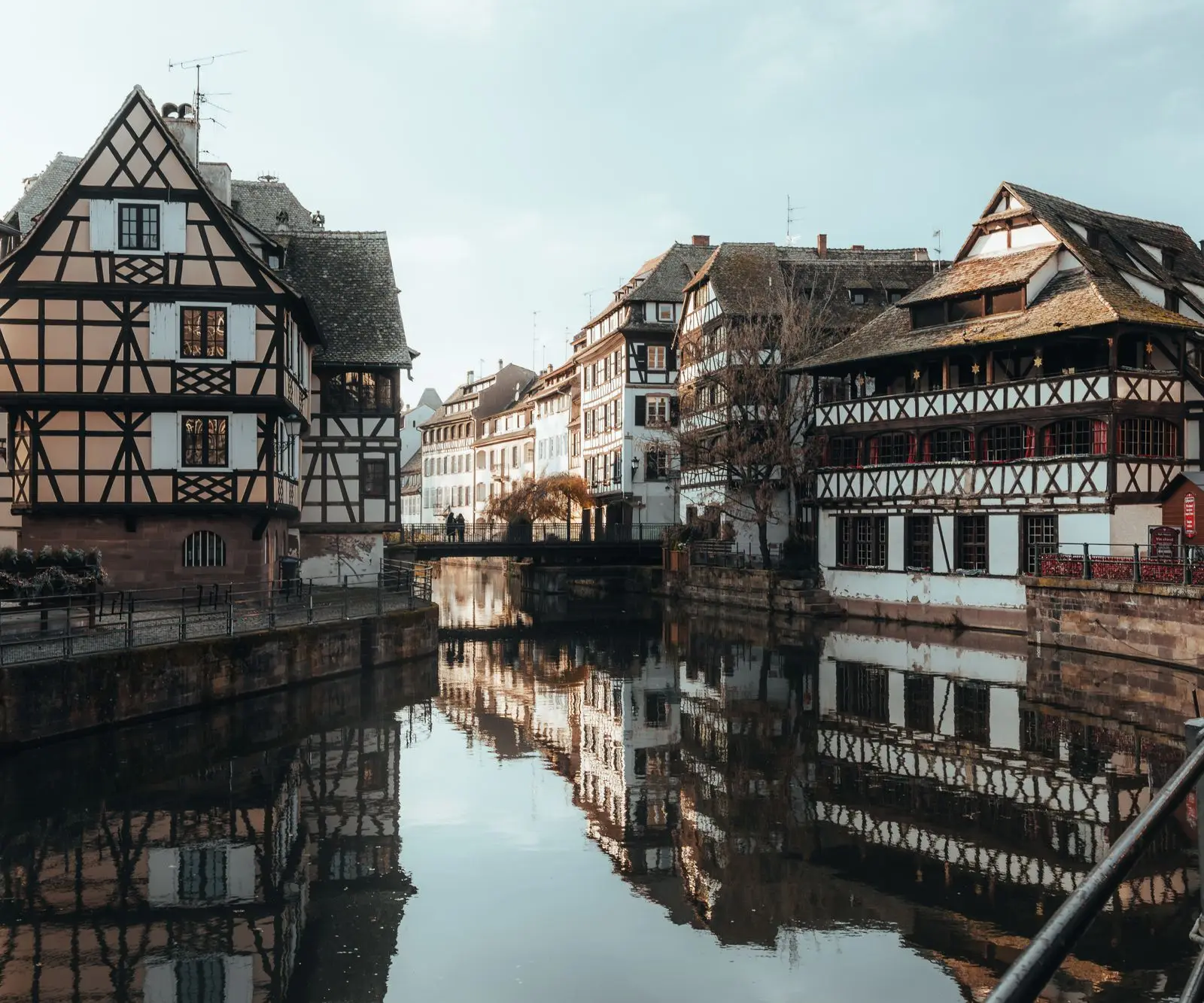
The Grande Île, the central island encircled by the river Ill, was the first entire city centre to be listed as a UNESCO World Heritage Site. At its western tip is Petite France, the old quarter of tanners, millers and fishermen, with half-timbered houses leaning over the canals.
The Ponts Couverts, with their medieval towers, and the Vauban Dam, whose terrace overlooks the whole district, are the best photo spots. In the late afternoon, with the lights coming on and reflections on the water, Petite France looks even more like a fairy tale.
Wander the streets around the cathedral, such as Rue du Bain-aux-Plantes and Place Kléber, and step into a winstub, Alsace's traditional taverns, with dark wood and checked tablecloths.
By boat through the canals and the European quarter
A boat trip on the Ill is the best way to see the city: it passes Petite France, the locks and the Neustadt, the late-nineteenth-century German district, also World Heritage, and reaches the European quarter.
Strasbourg is home to the European Parliament and the Council of Europe, and the modern glass buildings of the European quarter contrast with the medieval centre. Parliament visits are possible on certain days, mainly outside sessions.
The boat trip has an audio guide in several languages and lasts just over an hour. In summer, there are light shows at night on the cathedral and the riverside buildings.
The Christmas market: the Christkindelsmärik
Strasbourg calls itself the «Capital of Christmas», with some justification: the Christkindelsmärik is one of Europe's oldest Christmas markets, dating back to the sixteenth century. In December the whole city fills with lights, decorations and hundreds of stalls.
There's mulled wine, bredele, Alsace's Christmas biscuits, gingerbread, handmade decorations and a giant tree in Place Kléber. Each street has its own decorations, and house façades compete with lights and figures.
It's also the busiest time of year. Accommodation sells out early, prices rise and streets fill up. Weekdays and mornings are calmer.
The Alsace wine route
South of Strasbourg begins the Alsace wine route, a road of about 170 km through vineyards, villages of colourful houses and hilltop castles. Colmar, with its Little Venice, and villages such as Riquewihr, Eguisheim and Kaysersberg look like animated film sets.
Alsace wines are mostly aromatic whites: Riesling, Gewurztraminer, Pinot Gris and the sparkling Crémant d'Alsace. Many family wineries open their doors for tastings, at very reasonable prices.
For food, try choucroute garnie with meats and sausages, flammekueche, a thin tart with cream, onion and bacon, baeckeoffe, an oven stew, and kougelhopf, a tall cake with raisins. A private tour takes you to Colmar and the villages without worrying about the drive back after tastings.
A perfect day in Strasbourg
09:00
Cathedral
The façade, the interior and the climb to the platform.
10:30
Astronomical clock
The automata parade at half past twelve.
12:30
Lunch in a winstub
Flammekueche or choucroute with a Riesling.
14:00
Petite France
Half-timbered houses, the Ponts Couverts and the Vauban Dam.
15:30
Boat trip
Through the canals to the European quarter.
17:30
Place Kléber and the centre
Shopping, a coffee and a kougelhopf.
19:30
Dinner
Baeckeoffe and Alsace wine in a traditional tavern.
What it costs
Strasbourg has average French prices, but in December everything goes up. Alsace wines are among the best value in the country.
Budget
75–120 €
per person, per day
Hostel, Petite France on foot, flammekueche and mulled wine at the Christmas market.
Comfortable
160–280 €
per person, per day
Hotel in the centre, a canal boat trip, the cathedral platform and dinners in winstubs.
No expense spared
400–800 €
per person, per day
Boutique hotel in Petite France, a starred restaurant and a private tour of Colmar and the wine villages.
Hostel bed
per night · Much more expensive in December
30 € – 50 €
Mid-range hotel
per night, double room
90 € – 170 €
Boutique or luxury hotel
per night, double room
200 € – 400 €
Cathedral platform
per person
8 € – 10 €
Boat trip on the Ill
per person
15 € – 20 €
Lunch in a winstub
per person
15 € – 25 €
Dinner with wine
per person
25 € – 45 €
Flammekueche with a drink
per person
12 € – 20 €
Private wine-route tour
per person · With tastings
60 € – 120 €
Approximate reference values for 2026. Always check before you go.
Tourist mistakes to avoid
- ✕Coming in December without booked accommodation.
- ✕Arriving at the astronomical clock right on time and expecting to see anything. Come early.
- ✕Staying in the centre and skipping the wine route and Colmar.
- ✕Ordering beer in every winstub. Alsace's white wines deserve a taste.
- ✕Driving the wine route after several tastings.
- ✕Thinking Alsace is Germany. Or that it's just France. It's both, and neither.
«In Alsace, even the houses wear exposed beams and window boxes. It's a matter of style.»
More photos of Strasbourg
Frequently asked questions
How do I get from Lisbon to Strasbourg?
The easiest option is to fly to Paris and take the TGV, about an hour and fifty minutes. There are also connecting flights to Strasbourg or to Basel-Mulhouse airport.
When is the Strasbourg Christmas market?
Usually from late November to late December. It's one of the oldest in Europe and fills the city with lights and visitors.
When does the astronomical clock perform?
The automata parade takes place every day at around half past twelve. Arrive early to get in.
What is Petite France?
The old quarter of tanners and millers, with half-timbered houses over the canals, on the Grande Île, a UNESCO World Heritage Site.
Can I visit Colmar from Strasbourg?
Yes. Colmar is about half an hour by train or an hour by car, and a private tour can combine Colmar and the wine-route villages on the same day.
Prices, opening hours and rules are approximate reference values and may change: always check before you go. Photos: Pexels.