How long
4 to 5 days. Three days will do, but you'll be rushing the whole time.
Best time to go
May to October. June and July for the hydrangeas, April and May for the blue whales.
Getting there (from Lisbon)
Direct flight Lisbon–Ponta Delgada, about 2h15. Then a hire car or a transfer.
Ideal for
Nature, walking, thermal baths and anyone who doesn't mind a bit of drizzle.
Don't forget
A waterproof, a dark swimsuit (the iron-rich water stains) and shoes that can cope with mud.
São Miguel is the island where the volcano cooks lunch, the cows have better views than most hotels and the weather changes its mind more often than a teenager. In a single day you can get sun, fog, rain and, as a freebie, a rainbow. They call it the Green Island and that's no exaggeration: it's a green that's almost offensive if you're arriving from an August in the Alentejo. Bring your waterproof, your patience and your appetite.
Sete Cidades: two lakes, one legend and plenty of fog
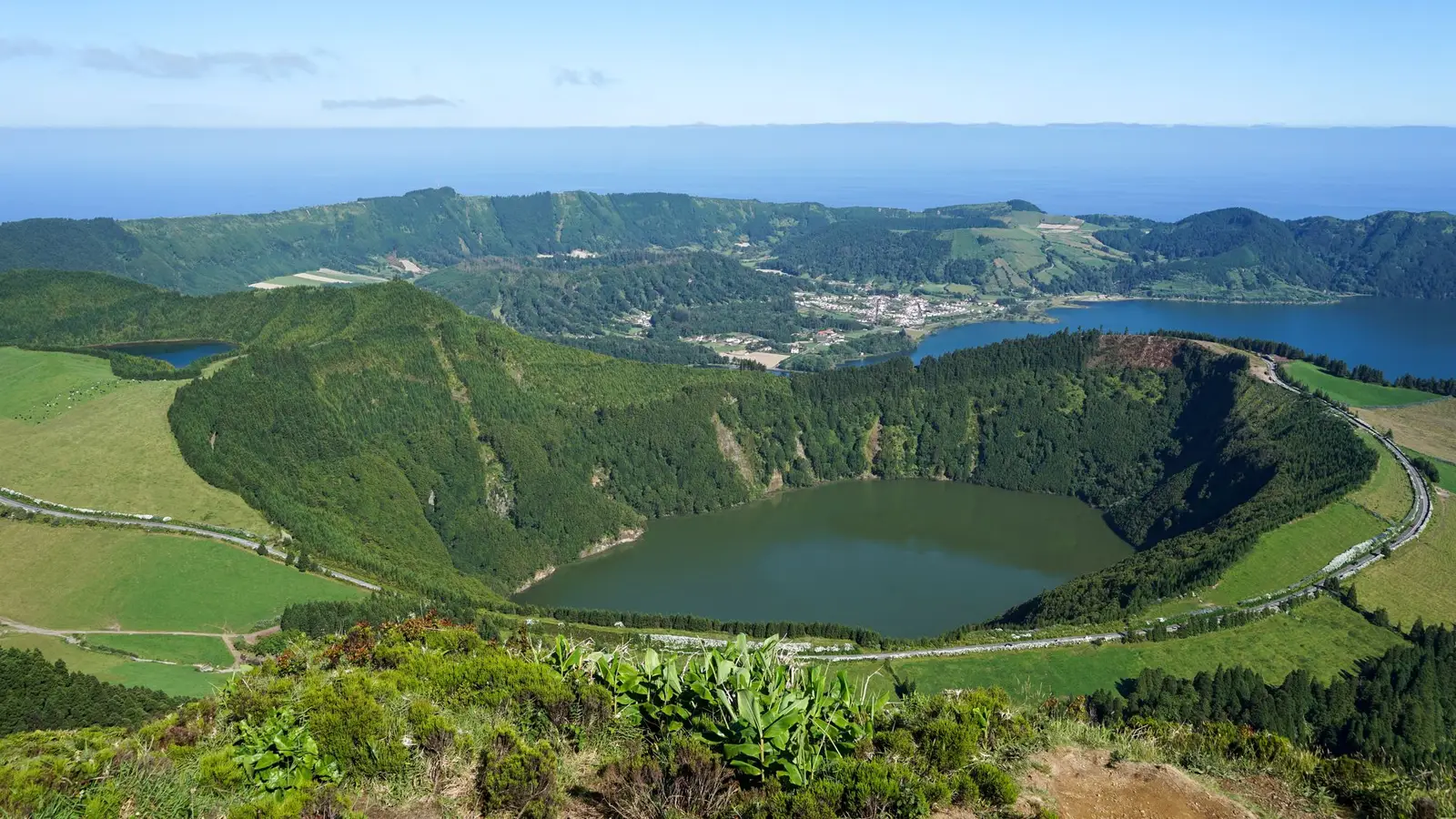
About 30 minutes' drive from Ponta Delgada, at the island's western tip, there's a giant crater with two lakes inside it: the Lagoa Azul (Blue Lake) and the Lagoa Verde (Green Lake), separated by a narrow bridge. Legend has it that a blue-eyed princess and a green-eyed shepherd cried so much when they said goodbye that their tears filled the two lakes. Science talks about depth and vegetation. Take whichever version you prefer. We're going with the princess.
The classic postcard is taken from the Miradouro da Vista do Rei, named after the visit of King Carlos and Queen Amélia in 1901. Right next door stands the skeleton of an enormous abandoned hotel, hugely popular with photographers. Going in is not a good idea: the building is crumbling, and the view outside is better anyway.
The best view of all, though, is from the Miradouro da Boca do Inferno. You park by the Lagoa do Canário and take a short walk of about 15 to 20 minutes through Japanese cedars to a rocky spur where you can see several lakes at once. On a clear day, it's one of those views that silences the whole group. On a foggy day, you see a white wall and hear someone say they should have stayed in bed.
Then head down to the village of Sete Cidades, with its little Igreja de São Nicolau and the lake on its doorstep. You can hire a kayak or a bicycle, or walk round the lake. To end the day in style, carry on to Mosteiros, with its sea stacks and one of the island's best sunsets, or to Ponta da Ferraria, where a hot spring mixes with the ocean. Bathing there only makes sense at low tide, and always holding on to the rope.
Lagoa do Fogo and Caldeira Velha: the wild heart
In the centre of the island, in the Serra de Água de Pau, Lagoa do Fogo is São Miguel's wildest lake: it's a nature reserve with no houses, no boats and no kiosks. There's water, green slopes and, on some days, seagulls acting as bouncers. The viewpoint is on the road linking the south coast to Ribeira Grande and, with clear skies, lets you see both coasts of the island at once.
For the more energetic, there's a trail down to the shore, where there's a small sandy beach. The way down is steep. The way up is the same thing in reverse, only with your legs complaining. In high season there may be parking restrictions near the viewpoints, so check before you go.
On the northern side of the mountains lies Caldeira Velha: tree ferns that look like they've wandered out of a dinosaur film, a waterfall of warm, rust-coloured water and thermal pools. There's an entrance fee and visitor numbers are controlled. Arrive early or late in the afternoon so you don't end up stewing alongside half a coach tour.
Just below is Ribeira Grande, with the Ponte dos Oito Arcos and Praia de Santa Bárbara, which has hosted international surfing competitions. Further along the north coast are the Gorreana and Porto Formoso tea plantations, a rarity in Europe. The rows of tea running down to the sea are gorgeous, and having a cup right there is practically compulsory.
Furnas: where the earth steams and lunch comes out of the ground
About 45 minutes to an hour from Ponta Delgada lies the Furnas valley, which smells faintly of boiled eggs. That's not poor hygiene on the village's part, it's sulphur. In the centre, caldeiras (boiling pools) bubble between the houses, alongside fumaroles and springs with different-tasting waters. At some of the spouts you can have a sip, but in moderation. Everything gives the impression that the earth is alive, and it is.
On the northern shore of Lagoa das Furnas are the vents where the pots for the famous cozido are buried, spending hours cooking in the volcano's heat. Watching the pots being hauled out of the ground in late morning is a show in itself. Nearby, the Ermida de Nossa Senhora das Vitórias, a neo-Gothic chapel half hidden among the trees, was commissioned in the 19th century by José do Canto. The trail around the lake is almost flat and very pleasant.
In the village, Parque Terra Nostra combines a botanical garden of centuries-old trees, camellias and ferns with a large, toasty thermal pool the colour of tea with milk. This is the official moment to wear that dark swimsuit: the iron-rich water stains light fabrics, and white never goes back to being white. The Poça da Dona Beija is smaller and cosier, with several hot pools, and is great for winding down at the end of the day.
Before leaving, climb up to the Miradouro do Pico do Ferro. From up there you can see the whole valley, with the lake, the village and the clouds of steam. It's the best way to realise you've spent the day wandering around inside a volcano.
Ponta Delgada and company: towns, villages and cows
The island's capital is built of black basalt and white lime, with pavements to match. The Portas da Cidade, three 18th-century arches, are everyone's meeting point. Next to them stands the Igreja Matriz de São Sebastião, with a Manueline portal worth two minutes of your attention. The seafront, the marina and the Forte de São Brás complete the stroll, and best of all, there are no Lisbon-style hills.
The Mercado da Graça is the place to see what the island produces: pineapples, passion fruit, just-landed fish, cheeses and flowers. In Fajã de Baixo, right next to the city, there are glass greenhouses where Azorean pineapples grow slowly, helped to flower with smoke. Each fruit takes about two years, which explains the price and justifies eating it with respect.
As a base, Ponta Delgada is the most practical: it has restaurants, nightlife and boat trips to see whales. Furnas is ideal if you want thermal baths at the end of the day, and Ribeira Grande is perfect for surfers. Vila Franca do Campo, the former capital until the 1522 earthquake, is calm, with a marina and famous queijadas.
In between there are pastures, stone walls, hydrangeas along the verges and cows. Lots of cows. The Azores produce an enormous share of the milk consumed in the country, and you can tell. The roads are good but full of bends, and it's common to get a tractor in front of you. Take a deep breath: you're on holiday.
Whales and dolphins: the moment everybody screams
The Azores are one of the best places in Europe to watch cetaceans, with more than twenty species recorded in these waters. Sperm whales are here all year round and dolphins turn up almost every time, often racing alongside the boat like excited dogs. In spring, especially April and May, the great migrants pass through: blue whales, fin whales and sei whales.
Trips leave mainly from the marinas at Ponta Delgada and Vila Franca do Campo and generally last between two and three hours. You can choose between a RIB, which is faster, more adventurous and wetter, and a catamaran, which is steadier and has somewhere to sit in the shade. The boats are guided by vigias, lookouts on land who spot the animals with binoculars from posts along the coast, a legacy of whaling, which in the Azores only ended in the 1980s.
If you tend to get seasick, take the tablet before boarding and not once you're already green. The Azorean Atlantic is not a swimming pool. Bring a jacket, even in August: it's always colder at sea than it looks from the quay.
These are wild animals and there are no guarantees. Many operators offer another trip if there are no sightings, so ask before you book. And when that enormous tail comes out of the water, put your phone away for a few seconds and look with your own eyes.
Eating and drinking: cozido, lapas and pineapple, treated with respect
The king of the table is the cozido das Furnas: beef, pork, chicken, chouriço and morcela, plus cabbage, potato, sweet potato, yam and carrot, all cooked for hours, buried by the lake. It comes out tender with a slight taste of earth, which is precisely the charm of the dish. In Furnas, book ahead, because it sells out, and don't plan anything for the afternoon. You'll need a nap.
From the sea come lapas grilled with butter, garlic and lemon, octopus, fried horse mackerel and fish such as boca-negra, cântaro and abrótea. For those who like a kick, pimenta da terra, a chilli paste, turns up on every table. Try it carefully, because it doesn't give any warning.
On the sweet side, look out for bolo lêvedo, round, fluffy and slightly sweet, great at breakfast with butter or filled. The queijadas de Vila Franca do Campo are small and dangerous: you eat one and you're already asking for just one more. Morcela with pineapple sounds odd on paper and makes perfect sense on the plate.
To drink, there's the tea from the north coast, passion fruit and pineapple liqueurs and a local passion fruit soft drink that islanders defend tooth and nail. With dinner, ask for Azorean wines, especially those from Pico island, mineral and tasting of the sea.
The secret: Nordeste and the Ilhéu de Vila Franca
Most visitors rush through Sete Cidades and Furnas and head back. Their loss. The Nordeste municipality, at the far eastern end, was once nicknamed the tenth island because of the isolation it suffered before modern roads. Today it's still peaceful, with huge cliffs, deep valleys and landscaped viewpoints that look hand-made, and were.
The Miradouro da Ponta do Sossego and the Miradouro da Ponta da Madrugada are the prettiest, and the second, as its name suggests, is for those who can handle an early start and a sunrise. The Farol do Arnel sits at the end of an extremely narrow and very steep road. On foot, you go down in no time. Going back up, faith is recommended. The Parque Natural da Ribeira dos Caldeirões, with its waterfall and restored water mills, is perfect for a break.
On the south coast is the Ilhéu de Vila Franca do Campo, a small semi-submerged volcanic crater with an almost circular natural pool, linked to the sea by a narrow channel. In summer there are boats from Vila Franca, but the number of visitors per day is limited, so book ahead. Bring a snorkel mask and plenty of enthusiasm for diving in.
On the way to Nordeste, stop at Povoação, where the island's first settlers landed, and at Faial da Terra, where the trail to the Salto do Prego waterfall begins. It's hours of bends with almost no traffic and scenery that makes you pull over every ten minutes.
Three days (plus a bonus) on São Miguel
Day 1 — morning
Sete Cidades
Check the webcam, head up to Vista do Rei and walk to Boca do Inferno while the sky is still clear.
Day 1 — afternoon
Village, kayak and hot water
Head down to the village of Sete Cidades, paddle a little on the lake and carry on to Ponta da Ferraria. Bathe at low tide only.
Day 1 — late afternoon
Sunset at Mosteiros
Watch the sun sink behind the sea stacks and have dinner in Ponta Delgada. Lapas are a must.
Day 2 — morning
Whales and dolphins
Boat trip from Ponta Delgada marina. Bring a jacket, a seasickness tablet and moderate expectations.
Day 2 — afternoon
Lagoa do Fogo and Caldeira Velha
Lagoa do Fogo viewpoint, a thermal soak at Caldeira Velha and tea at the north coast plantations.
Day 3 — morning
Furnas, steaming away
The village's caldeiras, the pots coming out of the ground by the lake and a stroll to the Ermida de Nossa Senhora das Vitórias.
Day 3 — lunch
Cozido das Furnas
Booked ahead, eaten without hurry. No big plans for the hours that follow.
Day 3 — afternoon
Terra Nostra and queijadas
A dip in the iron-rich pool, the view from Pico do Ferro and a return via Vila Franca do Campo to try the queijadas.
Day 4 — bonus
Wild Nordeste
Povoação, Ponta do Sossego, Ponta da Madrugada and Ribeira dos Caldeirões. Or the Ilhéu de Vila Franca, if it's summer.
How much it costs
São Miguel is not among the most expensive islands, but the car and the cozido do make themselves felt. The good news is that the viewpoints, the lakes and the cows don't charge admission.
Thrifty
70–110 €
per person, per day
Shared guesthouse for two, small car split between you, tascas and picnics with bread and cheese from the market. The viewpoints are free.
Comfortable
140–220 €
per person, per day
Good local lodging or hotel, your own car, a whale-watching trip, cozido in Furnas and thermal baths every day.
Spare no expense
300–550 €
per person, per day
Boutique hotel with a spa, private guided tours, dinners with Pico wines and a boat all to yourself.
Flight Lisbon–Ponta Delgada (return)
per person · Cheaper off-season and when booked in advance
60 € – 250 €
Local lodging or guesthouse
per night, double room
60 € – 120 €
4-star hotel
per night, double room
120 € – 250 €
Car hire
per day · Sells out in August, book early
30 € – 80 €
Fuel
per day
10 € – 25 €
Cozido das Furnas
per meal
18 € – 30 €
Simple meal at a tasca (local tavern)
per meal
12 € – 22 €
Whale and dolphin watching
per person
55 € – 85 €
Parque Terra Nostra
per person
10 € – 15 €
Caldeira Velha
per person · More expensive with bathing
3 € – 12 €
Poça da Dona Beija
per person
6 € – 10 €
Bolo lêvedo or queijada
each · The problem is that it's never just one
1 € – 3 €
Reference prices for 2026, approximate. Always check before you go.
Tourist mistakes to avoid
- ✕Driving up to Sete Cidades in thick fog without checking the webcam first. The lake won't appear just because you keep staring.
- ✕Thinking you can see the island in a day. It's only a few kilometres, but there are lots of bends, lots of stops and lots of cows.
- ✕Taking a white swimsuit to Terra Nostra. It comes out rust-coloured and no bleach will save it.
- ✕Turning up in Furnas at lunchtime without a cozido booking. The cozido sells out and, being buried, it can't be done in five minutes.
- ✕Stopping the car in the middle of the road to photograph hydrangeas. There are viewpoints with parking around every bend.
- ✕Planning every hour to the minute. In the Azores the weather is in charge, and the weather hasn't read your itinerary.
«In the Azores there's no such thing as bad weather. Just tourists in the wrong clothes.»
More photos of the Azores — São Miguel
Frequently asked questions
How many days do you need to visit São Miguel?
The ideal is 4 to 5 days. That gives you time to see Sete Cidades, Lagoa do Fogo, Furnas, the whales and Nordeste at a relaxed pace, with some leeway for the weather. With 3 days you can see the essentials, but you'll be rushing.
Do you need to hire a car on São Miguel?
Almost always. Public transport doesn't reach many of the viewpoints and lakes. The alternative is to combine transfers with day tours, especially if you don't like driving on mountain roads.
What is the best time to visit São Miguel?
From May to October the weather is more settled and the sea more pleasant. In June and July the hydrangeas are at their peak, and in spring the big migratory whales pass through. In winter it rains more, but there are also fewer people.
When can you see whales in the Azores?
Sperm whales and dolphins can be seen practically all year round. Blue, fin and sei whales pass mainly in spring, peaking in April and May. As these are wild animals, sightings are never guaranteed.
Where can you bathe in thermal waters on São Miguel?
The best-known places are Parque Terra Nostra and the Poça da Dona Beija, both in Furnas, Caldeira Velha, near Ribeira Grande, and Ponta da Ferraria, where the hot spring flows into the sea. Bring a dark swimsuit, because the iron-rich water stains.
Prices, opening hours and rules are approximate reference values and may change: always check before you go. Photos: Pexels.