How long
4 to 7 days. In 3 you'll see the essentials, rushing a little.
Best time
May, June, September and October: friendly sea, fewer queues, calmer prices.
Getting there (from Lisbon)
Car: about 2h30 to Faro on the A2 (3h to Lagos). Train: 3h to 3h30 to Faro. Express coach: 3h30 to 4h.
Ideal for
Beaches, clifftop walks, families, couples and anyone who takes grilled fish seriously.
Don't forget
Sunscreen, trail shoes and a jacket for the late afternoon in Sagres (yes, in August).
The Algarve is the place where half of Europe comes to sunbathe and the other half comes to photograph the first. But behind the postcards there are golden cliffs that look carved by someone with a lot of free time, sand islands you can only reach by boat and cataplanas that justify the trip on their own. The good news is that it all fits into about 200 km of coastline. The bad news is that you'll want to stay a few more days.
Lagos and Ponta da Piedade: the town that does everything well
If you had to pick a single base in the Algarve, many guides, this one included, would point to Lagos. It has a proper historic centre, with walls, cobbled pavements and streets where you get lost on purpose. It has beaches a few minutes' walk away and nightlife without being a nightclub with a sea view. Start with the Church of Santo António: there's so much gilded woodwork you'll want sunglasses inside.
Next door is the Slave Market, now a small museum. It's the uncomfortable part of history. It was in Lagos, in 1444, that enslaved Africans were landed, in one of the first episodes of the Atlantic slave trade. It's worth the few minutes it takes and reminds you that the Age of Discovery wasn't just caravels and pretty maps.
About 2 km from the centre is Ponta da Piedade: arches, pillars of golden rock, caves and advert-coloured water. A long staircase goes down almost to the sea, and from there small boats sail in and out of the caves. The boatmen give the rocks names and, with a bit of goodwill, you'll even see the camel. Nobody needs convincing that you saw the elephant.
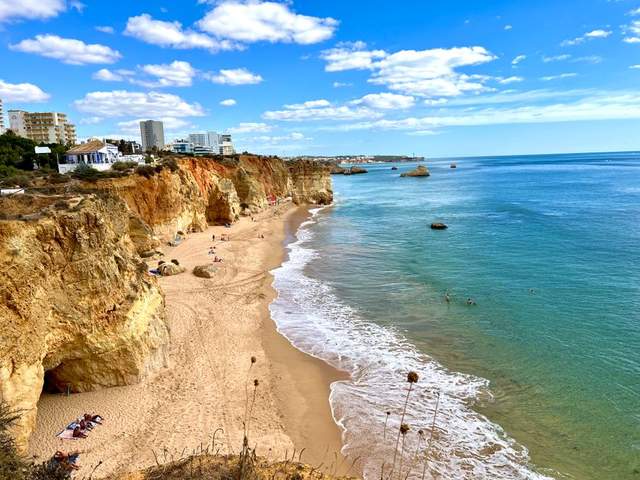
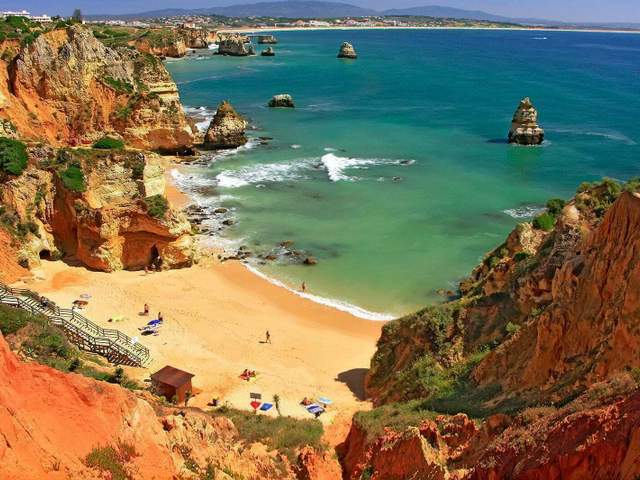
For beaches, you're spoilt for choice. Dona Ana and Camilo are the ones in the photos, and Camilo's wooden staircase counts as a trip to the gym. Porto de Mós is roomier. Meia Praia, with kilometres of sand, guarantees space for your towel even in August. To the west, the villages of Luz and Burgau are calmer versions of the same postcard.
Marinha, Benagil and the Seven Hanging Valleys
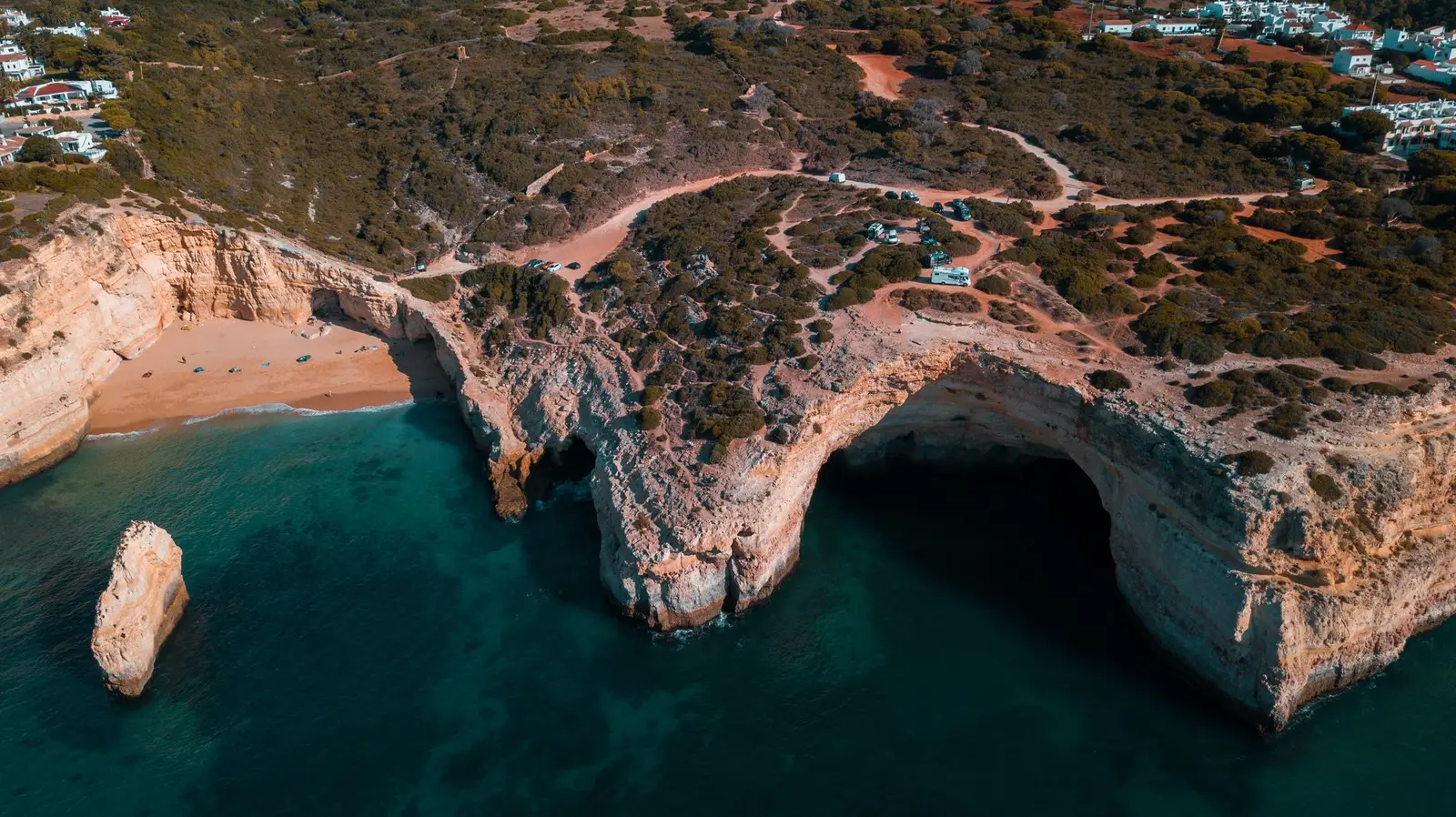
Between Carvoeiro and Armação de Pêra lies the stretch of coast that appears on half the desktop wallpapers on the planet. Praia da Marinha, in the Lagoa municipality, regularly makes lists of Europe's most beautiful beaches, and you can see why: golden cliffs, arches, rocks scattered in the sea and clear water when the sea is calm. You park at the top and walk down.
The best way to see it is to walk the Seven Hanging Valleys Trail. It's about 6 km (one way) between Marinha and Praia de Vale Centeanes, passing Benagil, Praia do Carvalho and the Alfanzina Lighthouse. The trail is easy, signposted and always along the clifftop, with zero shade. Translation: start early, take water and don't go near the edge for a selfie. The Algarve cliffs collapse more often than people think.
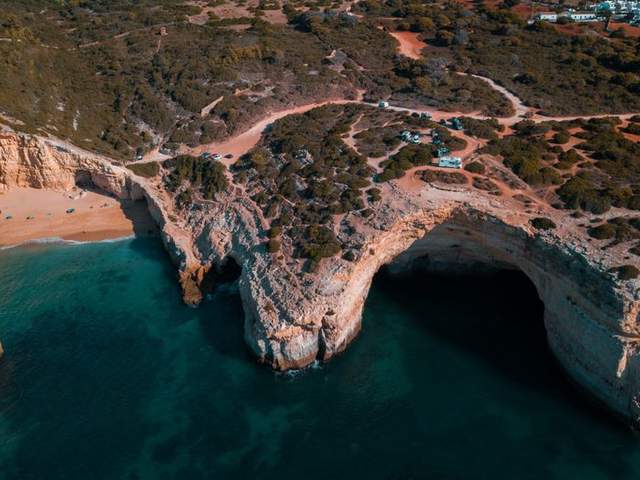
Then there's the star: the Benagil sea cave, with a hole in the roof through which light pours in like an opera set. You can see it from above, from the trail and behind the fences. The view that counts, though, is from inside, by boat or kayak. The rules have tightened in recent years and landing on the inner beach is no longer allowed. Check the rules in force and forget about swimming there from the beach.
Nearby is Carvoeiro, a former fishing village with white houses perched above a small beach. Follow the boardwalk to Algar Seco, a cluster of rocks sculpted by the sea, with nooks and natural pools that delight anyone who likes exploring at low tide.
Sagres and Cape St Vincent: the end of the world, with wind
Before anyone knew America existed, this was the edge of the map. Sagres is a small town of surfers and fishermen on a windswept spit of land. The Sagres Fortress occupies an entire headland over the Atlantic and is linked to the memory of Prince Henry the Navigator. Inside there's a huge stone compass rose whose origin historians still argue about. Tourists mostly argue about the wind.
About 6 km away is Cape St Vincent, the south-westernmost point of mainland Europe, with a lighthouse and sheer cliffs dozens of metres high. Sunset here is a ritual: lots of people, phones in the air and sometimes applause when the sun dips into the sea. Bring a jacket. That's not a suggestion, it's a prophecy.
For swimming, Martinhal and Mareta are more sheltered and good for families. Tonel and Beliche are surf territory. The water on this side is noticeably colder than in the rest of the Algarve, and the first dip usually comes with a rather undignified shriek.
North of Sagres, the Algarve changes character and enters the Southwest Alentejo and Vicentine Coast Natural Park: dark cliffs, wild beaches and little building. Arrifana is a must for surfers. At Odeceixe, the river meets the sea on a breathtaking beach. For walkers, the Rota Vicentina has trails along the coast.
Faro, Olhão, Tavira and the Ria Formosa: the Algarve of islands
East of Faro, the cliffs retire and the coast flattens out into salt marshes, channels and barrier islands of fine sand. This is the Ria Formosa Natural Park, a huge lagoon where you can see flamingos, storks and shellfish gatherers with rolled-up trousers. The water on this side is usually warmer, which, in the Atlantic, is saying a lot.
Many people only know Faro for its airport, which is a shame. In the Old Town, entered through the Arco da Vila, stands the Cathedral: climb the tower to see the lagoon from above. There are stork nests on almost everything tall. The Chapel of Bones, at the Carmo Church, lined with human bones, is the right visit for anyone who thinks they've seen it all.
In Olhão, the waterfront markets are two red-brick buildings, one for fish and the other for fruit and vegetables. On Saturday mornings the buzz doubles. Houses with flat roof terraces give the town an almost North African look. From here, boats leave for the islands of Armona and Culatra, car-free, with huge stretches of sand and a pace that makes watches feel optional.
Tavira is perhaps the prettiest town in the eastern Algarve, with its old bridge over the Gilão river, a castle with a garden, churches on every corner and distinctive hipped roofs. For the beach, take the boat from Quatro Águas to Ilha de Tavira. You can also go to Barril, where a little train crosses the lagoon to the sand and an anchor cemetery recalls the days when tuna fishing sustained the region.
At the table: cataplanas, octopus and fig sweets
Start with the cataplana, which is both the pot and the dish. The copper pot closes like a giant clam and cooks everything in its own steam. The seafood version is the classic, but there are fish, monkfish and pork-with-clams versions too. It arrives at the table closed and is opened with ceremony. A word of advice: the sauce left at the bottom isn't left behind; you mop it up with bread.
The rest of the menu comes from the sea. In summer there are grilled sardines, and Portimão holds a festival for them in August. Santa Luzia, next to Tavira, is known as the octopus capital. The Ria Formosa provides oysters, clams and razor clams: order arroz de lingueirão (razor clam rice) or xerém with wedge clams, the Algarve's cornmeal porridge. On the Vicentine Coast, goose barnacles are expensive, ugly and utterly addictive.
The sweets rest on three pillars: fig, almond and carob. Dom Rodrigo combines egg threads and almond, wrapped in coloured paper like a sweet with ambitions. There are morgados, queijinhos de figo (fig «cheeses») and almond sweets moulded into the shape of fruit. And there's the bola de Berlim (custard doughnut) sold on the sand, which in the Algarve is practically a public institution.
To drink, medronho (strawberry tree brandy) comes from the hills and doesn't forgive carelessness. Amarguinha, a bitter almond liqueur, is the sweeter version of the same sin. Algarve wines, especially from the Lagoa area, have improved a lot, and a chilled rosé with grilled fish is argument enough. To see it all together, go to the municipal market in Loulé, in a neo-Moorish building.
The secret: the Algarve without the sea
Many people spend their whole holiday without straying more than 2 km from the sand. It's a likeable mistake, but a mistake. Just 20 to 40 minutes' drive inland and the landscape swaps cliffs for orange groves, carob trees, cork oaks and hills. In January and February, almond blossom paints everything white and pink. In spring, the fields fill with wildflowers.
Silves was the great city of the Algarve in Moorish times, when it was called Xelb. The red sandstone castle dominates the town and is the most imposing in the region. Next to it, the Cathedral holds medieval tombs. In summer, the medieval fair fills the streets with torches, period costumes and fair food.
Further up, the Serra de Monchique is the roof of the Algarve. Fóia, at about 900 metres, is the region's highest point and, on a clear day, shows much of the coast below. Monchique village is good for buying medronho and cured sausages. At Caldas de Monchique there's a spa and a small cluster of houses among enormous trees, ideal for when the beach sun has given all it has.
On the other side, between Tavira and Vila Real de Santo António, lies Cacela Velha: white houses, a church and a small fort on a hilltop above the lagoon. At low tide, some people walk across to the beach. Sunset there is one of the calmest in the Algarve, with no applause and no crowds, just the seagulls commenting.
Three days in the Algarve, end to end
Day 1 — morning
Lagos on foot
Coffee and a pastry downtown, a walk along the walls, the Church of Santo António and the Slave Market. All flat: make the most of it, it won't last.
Day 1 — midday
Ponta da Piedade
Walk down the staircase, take a boat through the caves and have grilled fish for lunch in Lagos. Then a siesta at Dona Ana or Meia Praia.
Day 1 — late afternoon
Sunset at Cape St Vincent
About 40 minutes by car to Sagres. A loop of the fortress, jacket on and the sun sinking into the Atlantic.
Day 2 — early morning
Seven Hanging Valleys
Start at Praia da Marinha and walk to Benagil, or on to Vale Centeanes if your legs are up for it. Water, a hat and common sense near the edge.
Day 2 — lunch
Fish in Benagil or Carvoeiro
Sardines, horse mackerel or the catch of the day. Always ask the price per kilo before choosing.
Day 2 — afternoon
Inside Benagil or Silves
By kayak or boat, enter the cave and confirm the photos weren't lying. If the sea is rough, swap it for an afternoon at Silves castle.
Day 3 — morning
Olhão and the islands
Waterfront markets and a boat to Culatra or Armona. A car-free beach with no rush, but keep an eye on the last boat.
Day 3 — afternoon
Tavira
Old bridge, castle, hipped roofs and an ice cream by the Gilão. Those with energy left can stretch on to Cacela Velha for sunset.
Day 3 — dinner
Farewell cataplana
In Tavira or Santa Luzia, a seafood or octopus cataplana. Bread for the sauce and a medronho to finish, if someone else is driving.
What it costs
The Algarve has two prices: May's and August's. A bit like the sea, which also changes temper with the season.
Budget
70–110 €
per person, per day
Simple holiday let, dishes of the day, your own beach towel and the regional train between towns.
Comfortable
150–250 €
per person, per day
Mid-range hotel, hire car, a boat trip and fish dinners without doing the maths on the kilo.
No expense spared
350–800 €
per person, per day
Resort with a view, private tours, seafood every day and a sunbed always reserved.
Guesthouse or simple holiday let
per night, double room · At the top end in July and August
60 € – 130 €
Mid-range hotel
per night, double room
100 € – 230 €
Luxury hotel or resort
per night, double room
250 € – 650 €
Dish of the day at a tasca
per meal
12 € – 20 €
Fish or seafood dinner
per person · Fish by the kilo can climb quite a bit
25 € – 50 €
Seafood cataplana
per cataplana, for 2 people
40 € – 75 €
Coffee
per coffee
0,80 € – 1,50 €
Bola de Berlim on the beach
each · With custard it costs more and is a safer bet
2 € – 3,50 €
Boat trip to the caves
per person
20 € – 40 €
Guided kayak tour
per person
30 € – 55 €
Car hire
per day · Book early for summer
30 € – 90 €
Lisbon–Faro train
per person, one way
22 € – 35 €
Approximate reference values for 2026. Always check before you go.
Tourist mistakes to avoid
- ✕Sitting under the cliffs or walking near the edge. Rockfalls happen, and the warning signs aren't there for decoration.
- ✕Ignoring the red flag and the currents. The Atlantic is not a swimming pool, even when it makes an effort to look like one.
- ✕Arriving at the famous beaches at 11am in August and expecting a parking space. Go early or go late in the afternoon.
- ✕Trying to swim into Benagil from the beach. Besides being dangerous, current rules limit access: go by boat or kayak.
- ✕Choosing fresh fish without asking the price per kilo. The bill always arrives, and sometimes it arrives looking frightened.
- ✕Thinking the Algarve is small and staying in one place. From Sagres to Vila Real de Santo António is almost two hours by car.
«Bolas de Berlim here! With custard or without, the diet starts on Monday.»
More photos of the Algarve
Already packing?
Tours and transfers in Algarve
Frequently asked questions
What's the best area to stay in the Algarve?
It depends on what you're after. Lagos is the most balanced base for cliffs, caves and nightlife. Tavira and Olhão are ideal for islands, warmer water and a quieter atmosphere. Carvoeiro sits right in the middle, close to Marinha and Benagil.
How many days do you need to visit the Algarve?
With 3 days you'll see the essentials: Lagos, Sagres, Benagil and the Ria Formosa. To add proper beach time, the interior and the Vicentine Coast, 5 to 7 days is ideal.
How do you get from Lisbon to the Algarve without a car?
The train links Lisbon to Faro in about 3h to 3h30. There are also express coaches to several Algarve towns, taking 3h30 to 4h. Within the Algarve, the regional line connects Lagos to Vila Real de Santo António, but it's slow and doesn't reach the most famous beaches.
Is the sea cold in the Algarve?
It's the Atlantic, so it's fresh. On the eastern side, between Faro and Tavira, it's usually milder. In Sagres and on the Vicentine Coast it's considerably colder, even in high summer.
Can you go inside the Benagil cave?
You can visit it from inside by boat, kayak or paddleboard when the sea is calm. The rules have been tightened in recent years and landing on the inner beach is no longer allowed. Check the current rules before you go.
Prices, opening hours and rules are approximate reference values and may change: always check before you go. Photos: Pexels.