How long
One day covers the centre, the cathedral and Bom Jesus. With two, add Guimarães or a trip to Gerês.
Best time
Spring and autumn. Holy Week is the most intense time of the year, with processions and the whole city lit up.
Getting there (from Porto)
By train, between 40 minutes and just over an hour. By car it is about 55 km on the A3, around 45 minutes.
Ideal for
History lovers, fans of baroque architecture and anyone who enjoys lively cities with students and terraces.
Don't forget
Comfortable shoes for the Bom Jesus stairs, or some change for the funicular if you'd rather ride up.
There's a Portuguese saying: «Lisbon has fun, Porto works, Coimbra studies and Braga prays». The praying part is true: there are churches on almost every corner and a cathedral older than the country itself. But Braga is also a young city, full of students, gardens and cafés, where you eat very well and live without hurry. And it has one of the most beautiful stairways in the world, which nobody forces you to climb.
The centre: arches, gardens and terraces
Braga's historic centre is compact and almost entirely pedestrian. Start at Avenida Central and Praça da República, with the Arcada and its historic cafés, where locals have met for generations. From there, Rua do Souto, the oldest shopping street, leads to the cathedral past shops, pastry shops and façades with iron balconies.
Along the way is the Santa Bárbara Garden, set against the medieval wing of the former Archbishop's Palace, with flower beds that change through the year. It is one of the most photographed gardens in the country, especially in spring. A little further on is the Arco da Porta Nova, the city's baroque gateway, which at night looks like a stage set.
Braga was the Roman Bracara Augusta, founded more than two thousand years ago. Traces remain around the city, such as the Roman Baths of Alto da Cividade. Don't expect a Colosseum: expect very patient stones and a city that likes to remind you it was here first.
The cathedral and churches: the city of archbishops
Braga Cathedral is the oldest in Portugal, consecrated in the eleventh century, before the kingdom was founded. Over the centuries it collected styles: Romanesque, Gothic, Manueline and baroque coexist in the same building, sometimes on the same wall. Inside, the treasury, the chapels and the twin gilded organs are worth the guided visit.
For centuries Braga was the seat of the most powerful archbishops in the Iberian Peninsula, and it shows on every corner. There are richly decorated baroque churches, such as Congregados and Santa Cruz, and palaces like the Palácio do Raio, its façade covered in blue tiles. The Biscainhos Museum shows how the local nobility lived, with old-style gardens.
During Holy Week, the city transforms. There are solemn processions, decorated streets and thousands of visitors. If you come then, book accommodation well in advance and expect a busier, more moving Braga.
Bom Jesus do Monte: the stairway and the water-powered lift
About 5 km from the centre, the Sanctuary of Bom Jesus do Monte has been a UNESCO World Heritage Site since 2019. The highlight is the baroque stairway, with hundreds of zigzagging steps, fountains, chapels and statues representing the five senses and the virtues. Climbing it was traditionally an act of penance. Today it is also a great leg workout.
If you'd rather spare your knees, there is the Bom Jesus funicular, opened in the nineteenth century and powered by a water counterweight: the descending car fills a tank with water and pulls the other one up. It is one of the oldest of its kind still in service. Many people ride up and walk down, which is the smartest way.
At the top there is the basilica, gardens, a lake with little boats and a wide view over Braga. In the late afternoon the light turns golden and the stairway looks even more beautiful. Bring a jacket: it's windier up here than in the centre.
Sameiro: even higher up
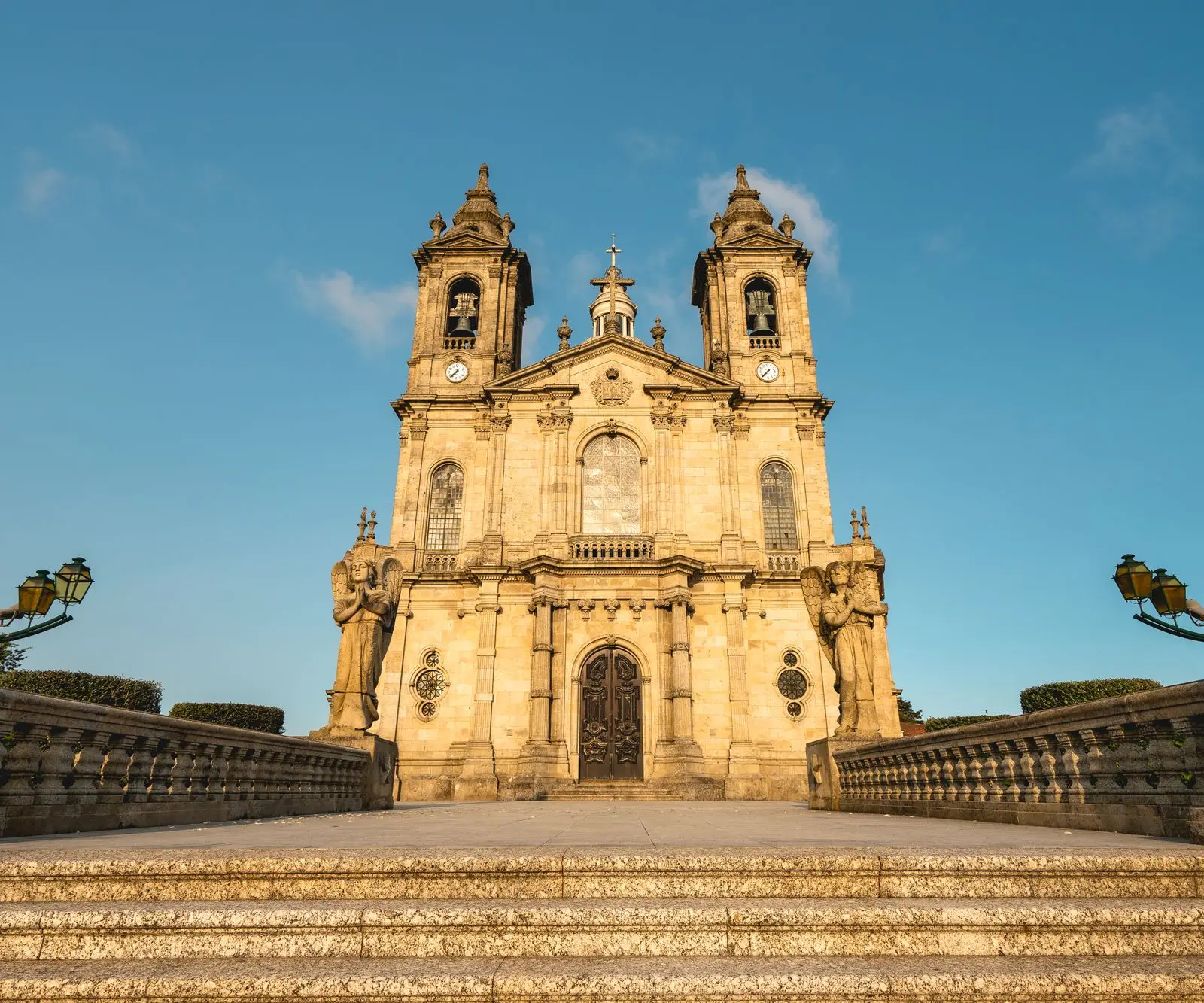
If you enjoyed Bom Jesus, keep climbing. A few kilometres away is the Sanctuary of Our Lady of Sameiro, one of the largest Marian sanctuaries in Portugal, with a monumental stairway and a white church on the hilltop.
The view from Sameiro is even wider than from Bom Jesus: on clear days you can see the city, the valleys and the mountains of the Minho. It's a peaceful, less touristy spot, good for a deep breath and a sunset.
Without a car, getting to Sameiro is tricky. A private tour or transfer lets you combine Bom Jesus and Sameiro in one afternoon, with time for photos and no bus timetables.
Around Braga: Guimarães and Gerês
Guimarães, the birthplace of Portugal, is about 25 km away. Its castle, the Palace of the Dukes of Braganza and the medieval centre, a UNESCO World Heritage Site, round off a day in Braga perfectly. Many visitors do both cities in a day, Braga in the morning and Guimarães in the afternoon.
About an hour away is Peneda-Gerês National Park, Portugal's only national park. Waterfalls, lagoons, stone villages, wild garrano horses and trails for all levels make it a paradise for nature lovers.
Coming from Porto, a private tour combining Braga and Guimarães is one of the most efficient ways to see the Minho in a single day, with door-to-door transport and stops wherever you like.
A perfect day in Braga
09:00
Coffee at the Arcada
Coffee and a frigideira on Praça da República, watching the city wake up.
09:45
Historic centre
Rua do Souto, the Santa Bárbara Garden and the Arco da Porta Nova.
11:00
Braga Cathedral
The country's oldest cathedral, with its treasury and gilded organs.
12:30
Lunch
Bacalhau à Braga or roast kid at a restaurant in the centre.
14:30
Bom Jesus do Monte
Funicular up, gardens, basilica and down the stairway on foot.
16:30
Sameiro
More view, fewer people and the best sunset in town.
19:30
Dinner in the centre
Petiscos and a chilled Vinho Verde in the streets around the cathedral.
What it costs
Braga is one of the most affordable cities in the north. You eat well for little, and the main sights are cheap or free.
Budget
50–90 €
per person, per day
Hostel, lunch specials, Bom Jesus on foot and plenty of free gardens. Braga is generous to backpackers.
Comfortable
110–190 €
per person, per day
Hotel in the centre, guided cathedral visit, the funicular, dinner with wine and an afternoon in Guimarães.
No expense spared
280–550 €
per person, per day
Boutique hotel, chef-led restaurants and a private tour combining Braga, Guimarães and Gerês at leisure.
Hostel bed
per night · More expensive during Holy Week
20 € – 35 €
Mid-range hotel or guesthouse
per night, double room
65 € – 120 €
Boutique hotel
per night, double room
140 € – 260 €
Bom Jesus funicular
per person, one way
2 € – 5 €
Cathedral treasury
per person
3 € – 6 €
Museums and palaces
per person · Some are free on certain days
3 € – 8 €
Lunch special
per meal
10 € – 16 €
Dinner with bacalhau à Braga and wine
per person
20 € – 38 €
Coffee and frigideira
per person
2 € – 4 €
Approximate reference values for 2026. Always check before you go.
Tourist mistakes to avoid
- ✕Climbing the Bom Jesus stairway at noon in August without water.
- ✕Rushing through the cathedral. The mix of styles is half the charm and takes time.
- ✕Coming during Holy Week without booked accommodation.
- ✕Staying in the centre and skipping Bom Jesus. It's Braga's image around the world.
- ✕Ordering «bacalhau à Brás» when you want bacalhau à Braga. They're different dishes, and both have fierce fans.
- ✕Going up to Sameiro without a jacket. Up there the wind ignores the seasons.
«In Braga there are no streets without a church. There are churches waiting for a street.»
More photos of Braga
Frequently asked questions
How do I get from Porto to Braga?
By train, between 40 minutes and just over an hour. By car it is about 55 km on the A3, around 45 minutes. A private tour lets you combine Braga and Guimarães on the same day.
How do I get up to Bom Jesus do Monte?
You can climb the baroque stairway on foot or take the Bom Jesus funicular, a nineteenth-century lift powered by a water counterweight. Many visitors ride up and walk down.
What is the most important church in Braga?
Braga Cathedral, the oldest in Portugal, consecrated in the eleventh century. It mixes Romanesque, Gothic, Manueline and baroque styles and has a treasury of great value.
What should I eat in Braga?
Bacalhau à Braga, roast kid, rojões and, for dessert, Abade de Priscos pudding. For a snack, frigideiras, puff pastries filled with meat.
When is Holy Week in Braga?
In the week before Easter. It's the city's most famous period, with processions and street decorations, and accommodation sells out early.
Prices, opening hours and rules are approximate reference values and may change: always check before you go. Photos: Pexels.