How long
A beach day, or just an afternoon with a sunset. It's so close you can come back several times.
Best time
June to September for swimming. In spring and autumn there are fewer people, good waves and lovely light.
Getting there (from Lisbon)
About 20 km over the 25 de Abril Bridge, around 25 minutes by car without traffic. Direct buses run from Lisbon, and there's a ferry to Cacilhas followed by a bus.
Ideal for
Families, surfers, groups of friends and anyone who wants a beach without spending the whole day travelling.
Don't forget
Leave Lisbon early on summer weekends. The bridge fills up, and so does your patience.
For Lisbon locals, going to Caparica is practically a verb. Just cross the 25 de Abril Bridge and, in under half an hour, a ribbon of sand more than 30 km long appears, with waves for every taste and restaurants where fish comes off the grill with a sea view. It isn't Portugal's quietest beach in August, but it's the most practical, the liveliest and one of the most beautiful at sunset. And as you head south, the crowds disappear and nature takes over.
The beaches: choose your tribe
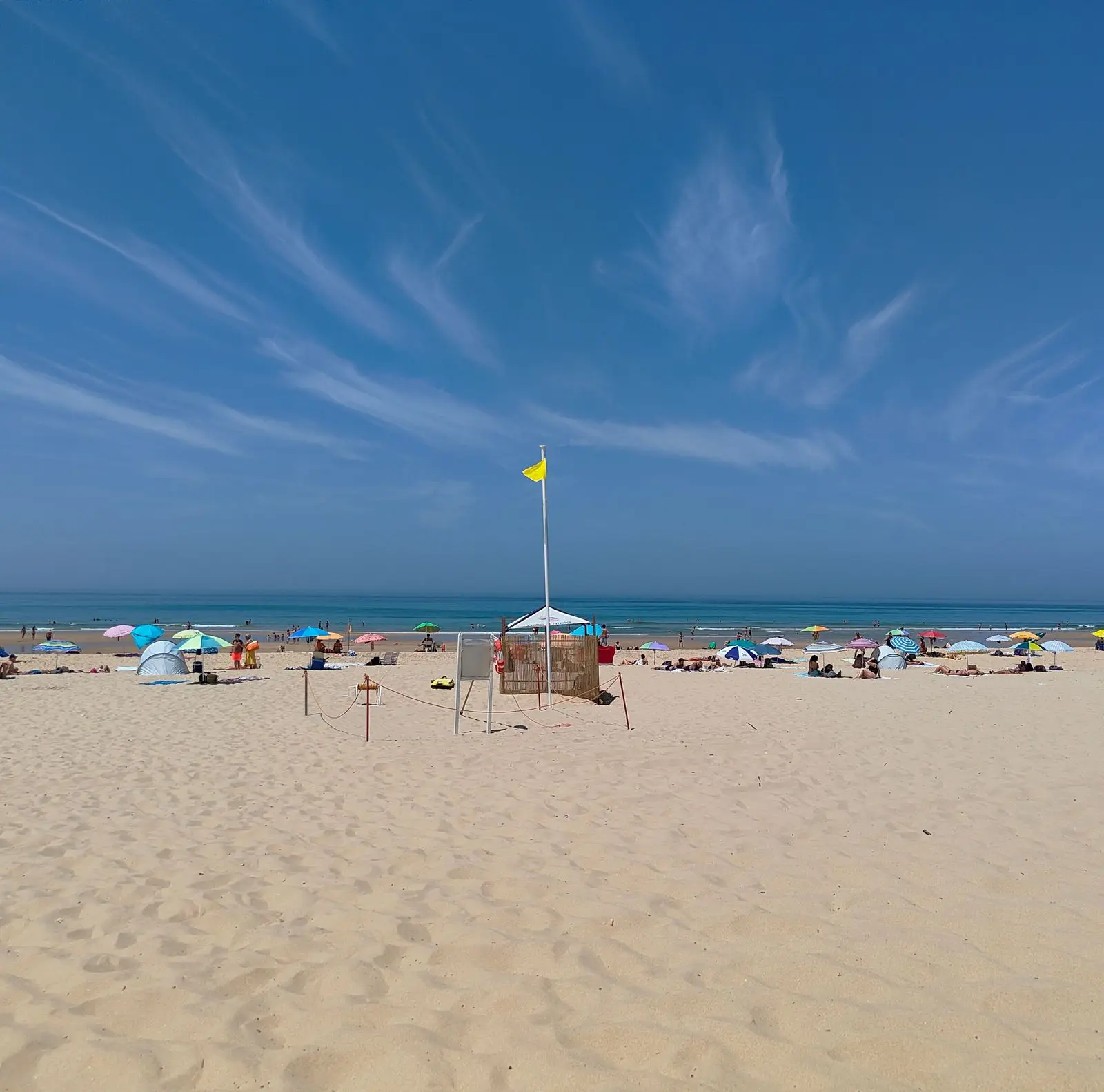
Costa da Caparica is an almost continuous string of beaches, each with its own style. Near the town, Tarquínio, CDS and Nova beaches are the most urban, with stone groynes, bars and lots of people. They're practical, well served by transport and lively.
Further south along the coast the mood changes: beaches like Rainha, Castelo, Bela Vista and Fonte da Telha are wider and calmer, with dunes and the Fossil Cliff behind them. The further you go, the more space on the sand and the more silence.
In summer, the Transpraia, a small open-air train, runs for several kilometres along the dunes and stops at many beaches along the way. It's a fun way to reach the more distant beaches without trudging across hot sand.
Surfing: Lisbon's school
Caparica is one of the best places to learn to surf near Lisbon. Waves are consistent almost all year and the beaches by the town have many schools, with beginner lessons and board and wetsuit included.
The groynes create more organised waves at certain spots, popular with local surfers. If you already surf, there are several breaks to explore along the coast, depending on wind and tide.
Even without a board, watching the surfers in the late afternoon, with the sun dropping into the sea and the boards in silhouette, is one of Caparica's free shows.
The Fossil Cliff: a cliff millions of years old
Behind the beaches rises the Fossil Cliff of Costa da Caparica, a sedimentary rock face with layers of different colours, protected as a landscape. The rocks hold fossils of marine animals from millions of years ago, when the sea reached here differently.
Next to the cliff is the Mata dos Medos, a pine forest planted in the eighteenth century to hold the dunes in place, with peaceful trails and shade. It's a good plan for a cool morning or to escape the beach wind.
From the top of the cliff, at viewpoints near Fonte da Telha and Capuchos, the view sweeps along the whole coast to Cabo Espichel. At sunset it's one of the most beautiful landscapes in the Lisbon region.
Almada and Cristo Rei
On the way to Caparica is Almada, the city across the Tagus. Its great landmark is the Sanctuary of Cristo Rei, with the statue of Christ with open arms over the river, inaugurated in 1959. A lift takes you up to the viewpoint, with a spectacular view over Lisbon, the bridge and the estuary.
Below, in Cacilhas, where the ferries from Lisbon arrive, there are many seafood and fish restaurants and a riverside walk facing the capital. Old Almada has viewpoints and a panoramic lift, Boca do Vento, that goes down to the river.
Combining Cristo Rei with an afternoon in Caparica is easy, especially with private transport. It's a way of seeing Lisbon from the outside, which is one of the best ways to see it.
Eating in Caparica: fish with your feet in the sand
Caparica's beach restaurants serve grilled fish, sardines in summer, squid, fried cuttlefish and seafood rice, often with tables on the sand and a sea view. At the end of the day, the beach bars become meeting points for the sunset.
In town, the simpler taverns and seafood places offer good prices and fresh fish of the day. There are also kiosks and Berliner doughnuts sold on the sand, an institution of Portuguese beaches.
In Cacilhas, by the river, the seafood restaurants are a classic for dinner before taking the ferry back to Lisbon, with the city lit up across the water.
A perfect day at Costa da Caparica
09:30
Cristo Rei
Up to the viewpoint with Lisbon and the bridge at your feet, before the heat.
10:30
Surf lesson
Two hours at a beach by the town, with board and wetsuit included.
13:00
Beach lunch
Grilled fish or fried cuttlefish at a restaurant with tables on the sand.
15:00
Southern beaches
Transpraia or car to the quieter beaches by the Fossil Cliff.
17:30
Fossil Cliff
A viewpoint on top of the cliff, with the coast stretching to Cabo Espichel.
19:00
Sunset
A drink at a beach bar as the sun sinks into the Atlantic.
20:30
Dinner in Cacilhas
Seafood by the river and back to Lisbon by ferry.
What it costs
Caparica is one of the most affordable beaches in the Lisbon region. The priciest things are a sunbed in the busiest areas and, of course, seafood.
Budget
45–85 €
per person, per day
Bus from Lisbon, a towel, the free beach, a sandwich and a Berliner doughnut. The sunset costs nothing.
Comfortable
110–200 €
per person, per day
Car or transfer, a surf lesson, beach lunch, Cristo Rei and dinner in Cacilhas.
No expense spared
260–520 €
per person, per day
Sea-view hotel, private lesson, reserved sunbed and umbrella, and private transport so you never think about the bridge.
Hostel bed or surf house
per night
25 € – 45 €
Mid-range hotel or apartment
per night, double room · More expensive in August
70 € – 140 €
Sea-view hotel
per night, double room
150 € – 300 €
Group surf lesson
per person, about 2 hours · Board and wetsuit included
25 € – 45 €
Transpraia
per person, per trip · Summer only
5 € – 10 €
Berliner doughnut on the beach
each
3 € – 6 €
Lunch special
per meal
12 € – 18 €
Fish dinner with wine
per person
22 € – 40 €
Cristo Rei lift
per person
3 € – 5 €
Approximate reference values for 2026. Always check before you go.
Tourist mistakes to avoid
- ✕Crossing the bridge at five on an August Sunday and expecting to get there quickly.
- ✕Swimming outside lifeguarded areas. The Atlantic currents here are treacherous.
- ✕Climbing the Fossil Cliff for a photo. It's fragile, protected and dangerous.
- ✕Sticking to the beaches by the town and thinking that's Caparica. The best is further south.
- ✕Leaving valuables alone on your towel while you swim.
- ✕Turning down the Berliner doughnut because of a diet. Nobody regrets one.
«Lisbon has a river. Caparica is where Lisbon goes to find the sea.»
More photos of Costa da Caparica
Already packing?
Tours and transfers in Costa da Caparica
Frequently asked questions
How do I get from Lisbon to Costa da Caparica?
By car it is about 20 km over the 25 de Abril Bridge, around 25 minutes without traffic. Direct buses run from Lisbon, and there's also a ferry to Cacilhas followed by a bus. A transfer avoids the queues and parking.
What is the best beach at Costa da Caparica?
It depends on what you want. For a lively atmosphere and transport, the beaches by the town. For calm and nature, the southern beaches near Fonte da Telha and the Fossil Cliff.
What is the Transpraia?
A small open-air train that runs in summer along the dunes, stopping at several beaches. It's handy for reaching the more distant ones.
Is Costa da Caparica good for surfing?
Yes, especially for learning. Waves are consistent most of the year and there are many surf schools near the town.
Can I visit Cristo Rei on the same day?
Yes. Cristo Rei is in Almada, on the way between Lisbon and Caparica. A visit to the viewpoint takes about an hour.
Prices, opening hours and rules are approximate reference values and may change: always check before you go. Photos: Pexels.