How long
Two to three days for the city and the Calanques. With more time, Marseille is a good base for Provence.
Best time
Spring and autumn. Summer is hot and access to some calanques may be restricted due to fire risk.
Getting there (from Lisbon)
There are direct flights from Lisbon to Marseille of about two hours and twenty minutes. From Paris, the TGV takes just over three hours.
Ideal for
Anyone who likes authentic cities with character, sea, markets, food and a certain friendly chaos.
Don't forget
Hiking shoes for the Calanques, and water, lots of water.
Marseille is France's oldest city, founded by Greeks more than 2,600 years ago, and it has the confidence of a place that has seen everything. It's loud, mixed, passionate about its football club and its port, and for years it had a bad reputation. Today it's one of the liveliest cities in the Mediterranean, with new museums, old quarters full of street art and, a few kilometres away, a national park of turquoise coves between white cliffs. Marseille doesn't ask to be liked. But almost everyone ends up liking it.
The Vieux-Port: the heart of the city
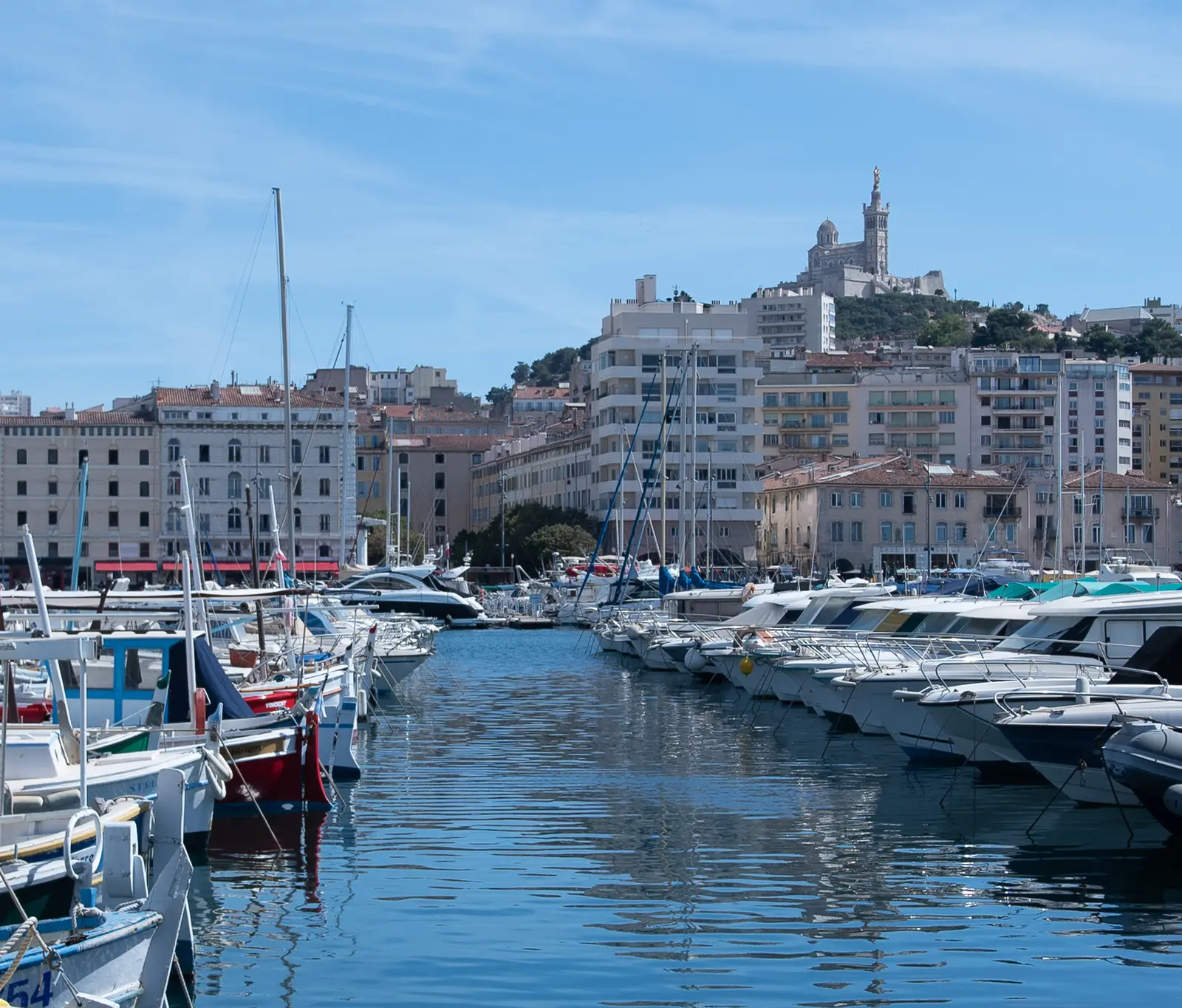
The Vieux-Port, the old port, is where Marseille was born and where it still lives. In the morning, fishermen sell the fresh catch straight from their boats on the quay. During the day, the port fills with sailboats, terraces and strollers.
On one side is the Ombrière, a huge mirrored canopy designed by architect Norman Foster, where people photograph themselves upside down. The forts of Saint-Jean and Saint-Nicolas guard the harbour entrance, as they have for centuries.
Boats leave the port for the Château d'If, the island fortress made famous by Alexandre Dumas's novel «The Count of Monte Cristo», and for the Frioul archipelago, with coves and trails.
Notre-Dame de la Garde: the Good Mother
At the city's highest point stands the nineteenth-century basilica of Notre-Dame de la Garde, topped by a huge golden statue of the Virgin and Child. Locals call her «la Bonne Mère», the Good Mother, and believe she protects sailors and the city.
Inside are golden mosaics and hundreds of ex-votos, mostly small boats and paintings offered by shipwreck survivors. Outside, the view is Marseille's best: the whole city, the port, the islands and the sea to the horizon.
You climb on foot, a steep walk, or by bus or tourist train. In the late afternoon, the light over the city and the sea is unforgettable.
The Panier, the MuCEM and La Major
Le Panier is Marseille's oldest quarter, on the hill by the port. Narrow streets, stairways, laundry drying, street art on every wall and little shops of craftspeople and Marseille soap. At its centre is the Vieille Charité, a former almshouse with a beautiful chapel and museums.
By the sea, the MuCEM, the Museum of European and Mediterranean Civilisations, is a cube wrapped in concrete lace, linked by a footbridge to Fort Saint-Jean. Even without seeing the exhibitions, it's worth walking the terraces and the bridge over the water.
Next door is La Major Cathedral, enormous, striped in two colours of stone, looking more Byzantine than French. At sunset the ensemble is one of the city's most photogenic.
The Calanques: coves between white cliffs
Between Marseille and Cassis stretches the Calanques National Park, created in 2012: white limestone cliffs plunging into a turquoise sea, forming narrow, deep inlets. It's one of the most impressive landscapes in the Mediterranean, right on the doorstep of a big city.
Some calanques, such as Sormiou and Morgiou, have small fishing hamlets and road access at certain times. Others, such as Sugiton or En-Vau, can only be reached on foot, via demanding trails, or by boat. In summer, access may be restricted due to fire risk, so check beforehand.
The easiest way to see them is on a boat trip from the Vieux-Port or from Cassis, a charming fishing town to the east with vineyards and a colourful harbour. A private tour can combine Cassis and the Calanques on the same day.
Eating in Marseille: bouillabaisse and much more
Bouillabaisse is Marseille's dish: a saffron soup of rockfish, served first as broth with toasted bread and rouille, a garlic and chilli sauce, then with the whole fish. It's expensive, takes time and is only genuine at restaurants that respect the recipe. Be wary of cheap ones.
There's much more: panisse, fried chickpea sticks, navettes, boat-shaped biscuits with orange blossom, aïoli with salt cod and vegetables and, of course, pastis, the aniseed drink taken with water in the late afternoon.
Marseille is also a multicultural city, with North African, Italian, Armenian and Corsican influences. The markets of the Noailles district are a journey within the journey, with spices, bread and sweets from all over the Mediterranean.
A perfect day in Marseille
09:00
Vieux-Port
The fish market on the quay and coffee overlooking the boats.
10:30
Notre-Dame de la Garde
The Good Mother and the view over the whole city.
12:30
Le Panier
Narrow streets, street art and the Vieille Charité.
14:30
Lunch
Panisse and grilled fish on a terrace in the Panier.
17:00
Calanques by boat
Turquoise coves between white cliffs, from the Vieux-Port.
19:00
MuCEM
The footbridge and terraces at sunset.
21:00
Bouillabaisse
The city's most famous dinner, at a restaurant that respects the recipe.
What it costs
Marseille is cheaper than Nice or Paris. Bouillabaisse and boat trips are the luxuries worth paying for.
Budget
75–120 €
per person, per day
Hostel, the Noailles markets, the Panier and Notre-Dame on foot, and a Calanques trail.
Comfortable
160–280 €
per person, per day
Hotel by the port, the MuCEM, a Calanques boat trip and a fish dinner.
No expense spared
400–850 €
per person, per day
Sea-view hotel, traditional bouillabaisse and a private tour to Cassis and the Calanques.
Hostel bed
per night
30 € – 50 €
Mid-range hotel
per night, double room
90 € – 170 €
Luxury sea-view hotel
per night, double room
200 € – 450 €
MuCEM
per person
11 € – 15 €
Boat to the Château d'If
per person, return · Castle entry is separate
12 € – 20 €
Calanques boat trip
per person
30 € – 50 €
Menu of the day at lunch
per meal
15 € – 25 €
Traditional bouillabaisse
per person · Usually for two
60 € – 120 €
Fish dinner with wine
per person
20 € – 40 €
Approximate reference values for 2026. Always check before you go.
Tourist mistakes to avoid
- ✕Eating a cheap bouillabaisse and thinking it's the real thing.
- ✕Hiking to the Calanques in summer without checking whether access is open.
- ✕Doing the Calanques trails in flip-flops and without water.
- ✕Badmouthing Olympique de Marseille anywhere in the city.
- ✕Leaving valuables visible in the car or on the beach. As in any big city, stay alert.
- ✕Thinking Marseille is just a port. The Panier, the Corniche and the Vallon des Auffes deserve time.
«In Marseille, even the sardine that blocked the harbour is true. At least for whoever's telling it.»
More photos of Marseille
Frequently asked questions
How do I get from Lisbon to Marseille?
By plane, there are direct flights of about two hours and twenty minutes. From Paris, the TGV takes just over three hours.
How do I visit the Calanques?
By boat from the Vieux-Port or Cassis, or on foot via demanding trails. In summer, access may be restricted due to fire risk; check before going.
What is bouillabaisse?
A saffron soup of rockfish served with toasted bread and rouille, then with the fish. It's Marseille's most famous dish and, when genuine, isn't cheap.
What is Notre-Dame de la Garde?
The basilica at Marseille's highest point, with a golden statue of the Virgin, the «Good Mother», and the best view of the city.
Can I visit Cassis from Marseille?
Yes. Cassis is about 30 km away, and many visitors combine the town and the Calanques on the same day, by boat or on a private tour.
Prices, opening hours and rules are approximate reference values and may change: always check before you go. Photos: Pexels.